
Octave Yardsticks
Melody: Part 7

This time, we’re going to see how octaves simplify melodic pitch recognition, no matter how far those pitches are from each other.
If that sentence made no sense whatsoever, I’d recommend going through the earlier parts of this series:
Unravelling the Spiral
It’s nice to have two views — a front view and a top view — to clarify our sense of pitch symmetry (Part 5).
It’d be even nicer to have just one.
Let’s take what we’ve learnt about octaves from the top view (Part 6) and incorporate it into the front view. This way, we can go back to representing pitches using only points and lines.
Let’s use a new melody as an example:
Earlier, the front view of this melody would have looked like this:
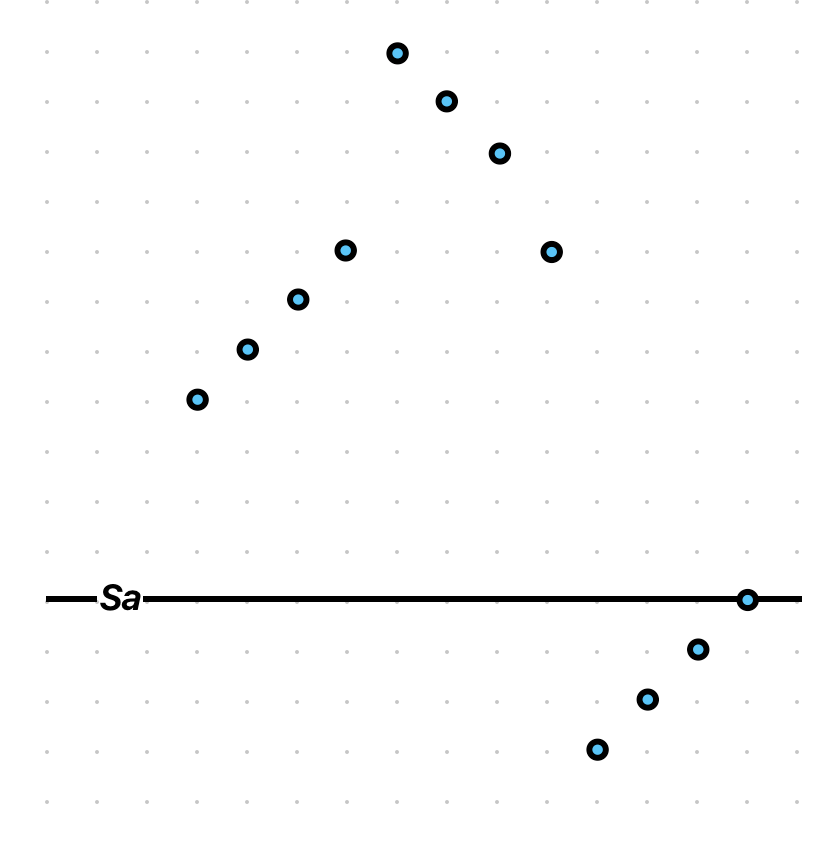
This doesn’t take advantage of the octave-symmetry of pitch, and we end up having to compare every pitch with the baseline Sa.
Some of these pitches are very far from Sa, and accurately judging line length becomes progressively harder with increasing length.
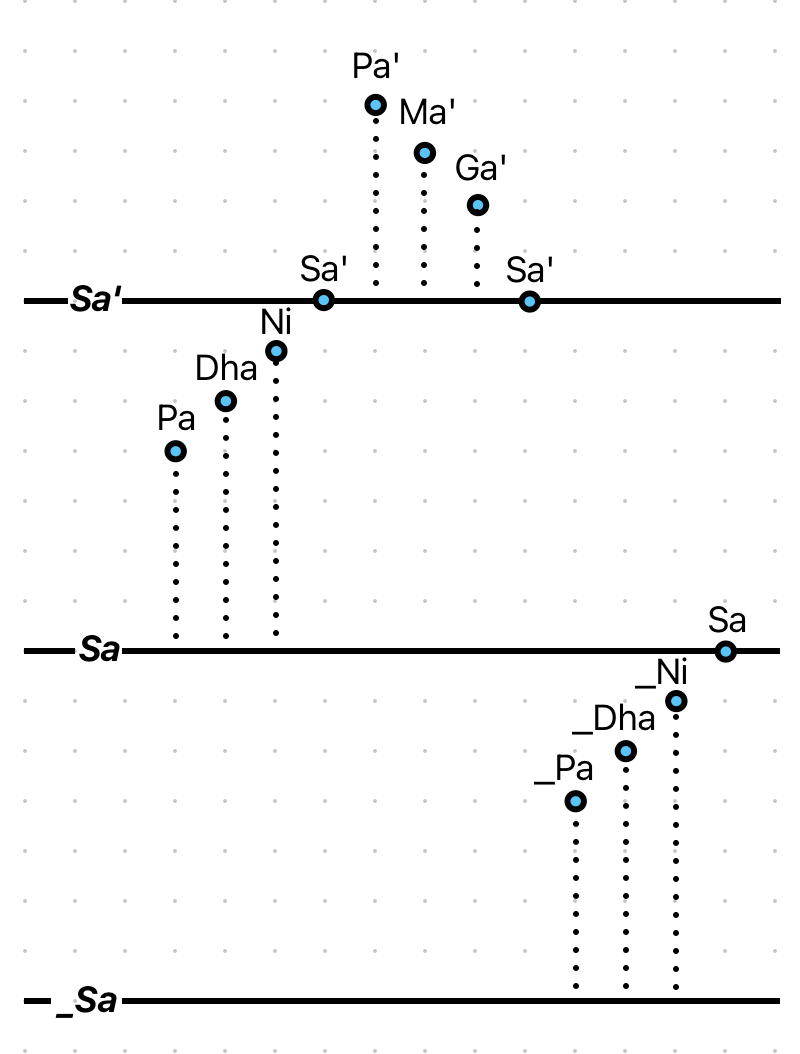
Let’s remedy this by adding a line at Sa', an octave higher than the baseline Sa.
Our picture changes with this addition:
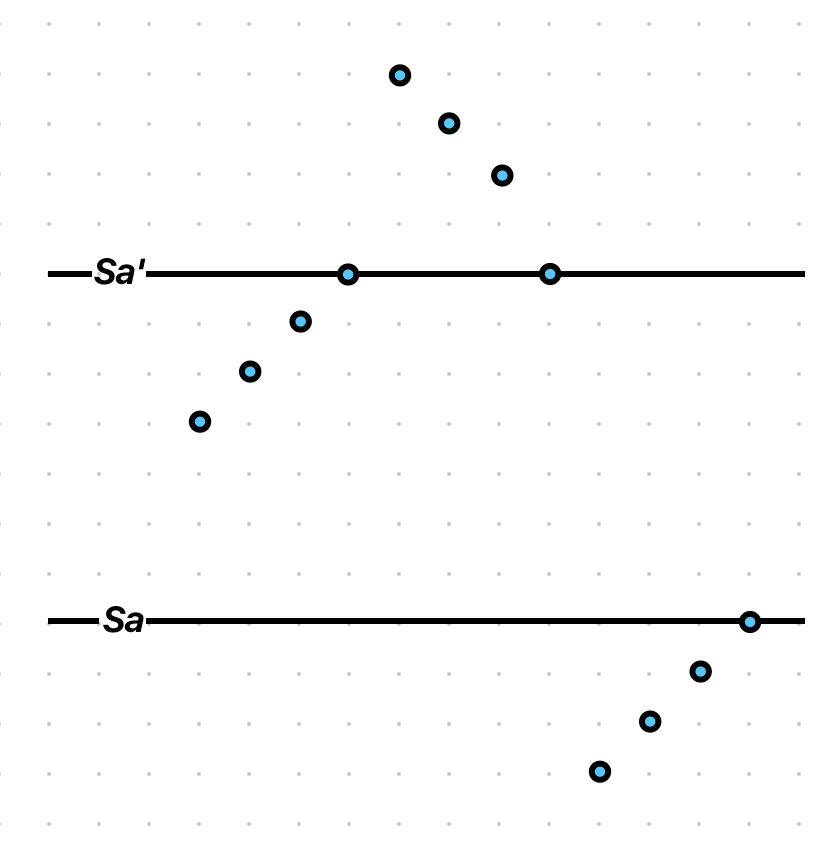
This makes it much easier to recognise heights at a glance. We can extend this scheme and add lines for all the pitches that are one or more octaves away from Sa. Here’s a compact view:
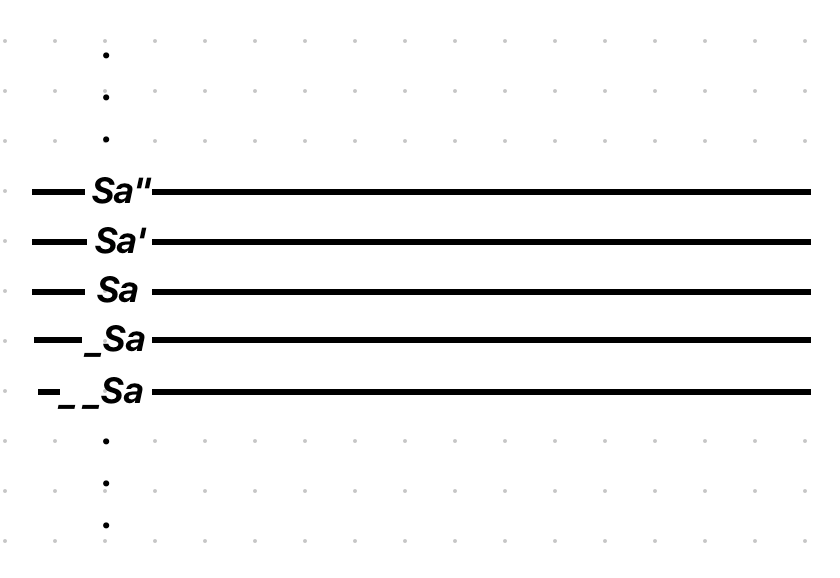
Since all the octave lines are drawn at some version of Sa, we can just call these Sa-lines.
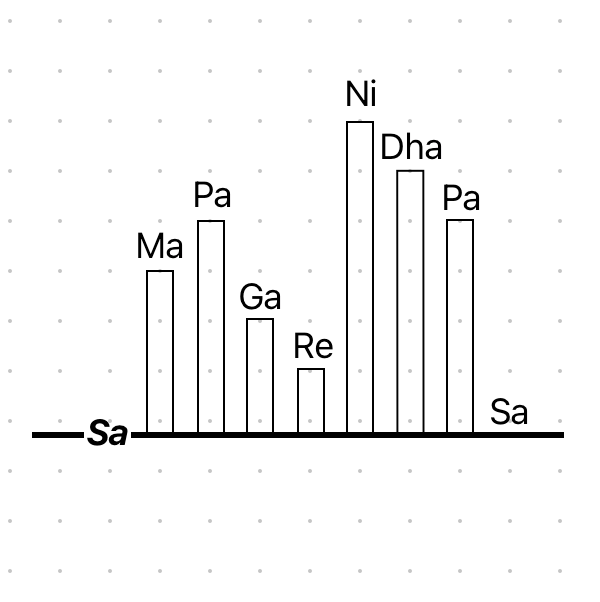
The number of Sa-lines we fill in depends on the specific pitches in the melody. For instance, in our central melody example in this series (Ma Pa Ga Re Ni Dha Pa Sa), we only need one line (Sa), because the entire melody uses only the base pitches Sa, Re,…, Ni:
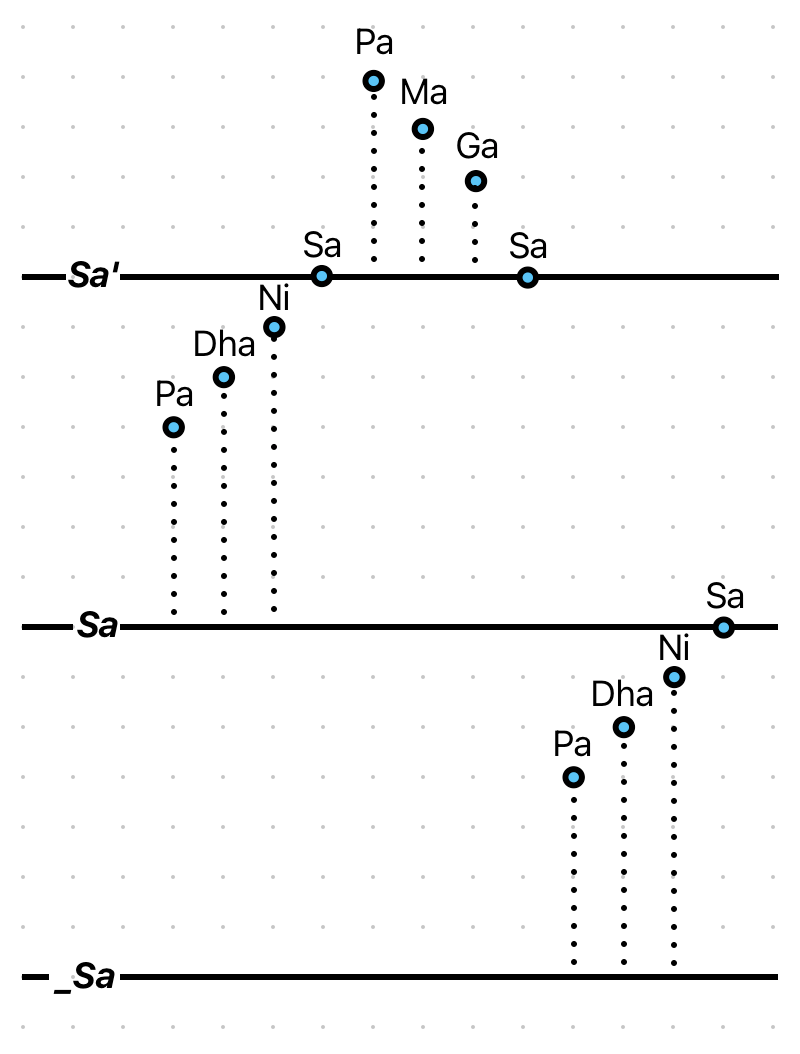
In our latest melody example, we’d need three horizontal lines — for _Sa, Sa and Sa'. Let’s see how that looks:
3-Octave Dictionary
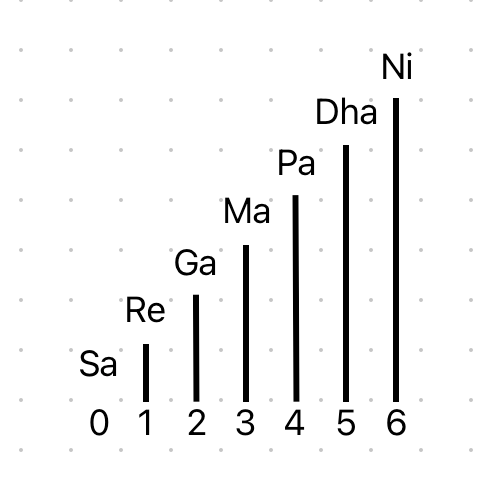
We are now in a position to extend our 7-line dictionary (Part 3). Here’s the simplified front view:
We’ll now expand it to a 3-octave dictionary:
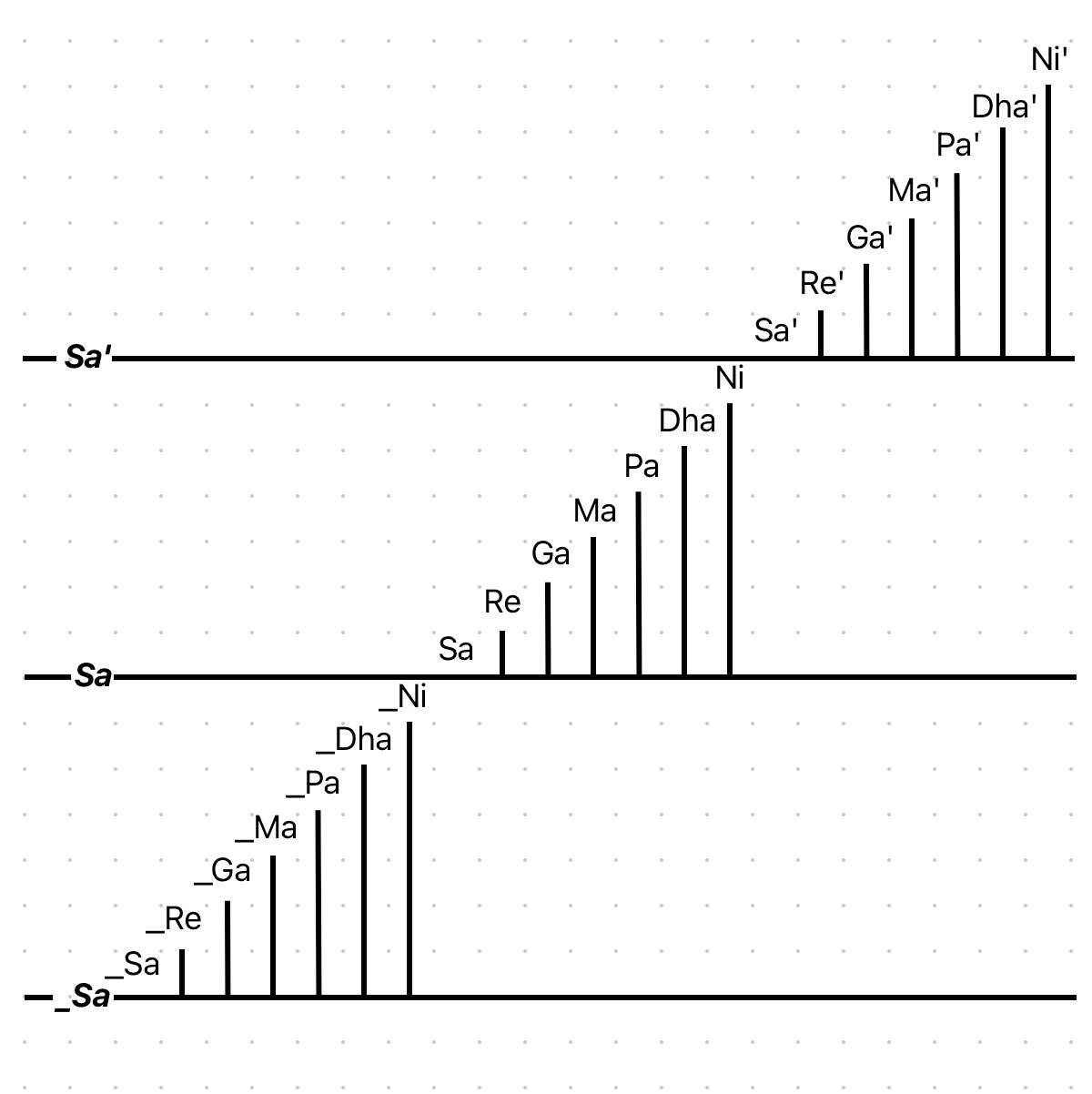
It’s still essentially a 7-interval dictionary, but repeated over 3 octaves. Let’s simplify it a bit.
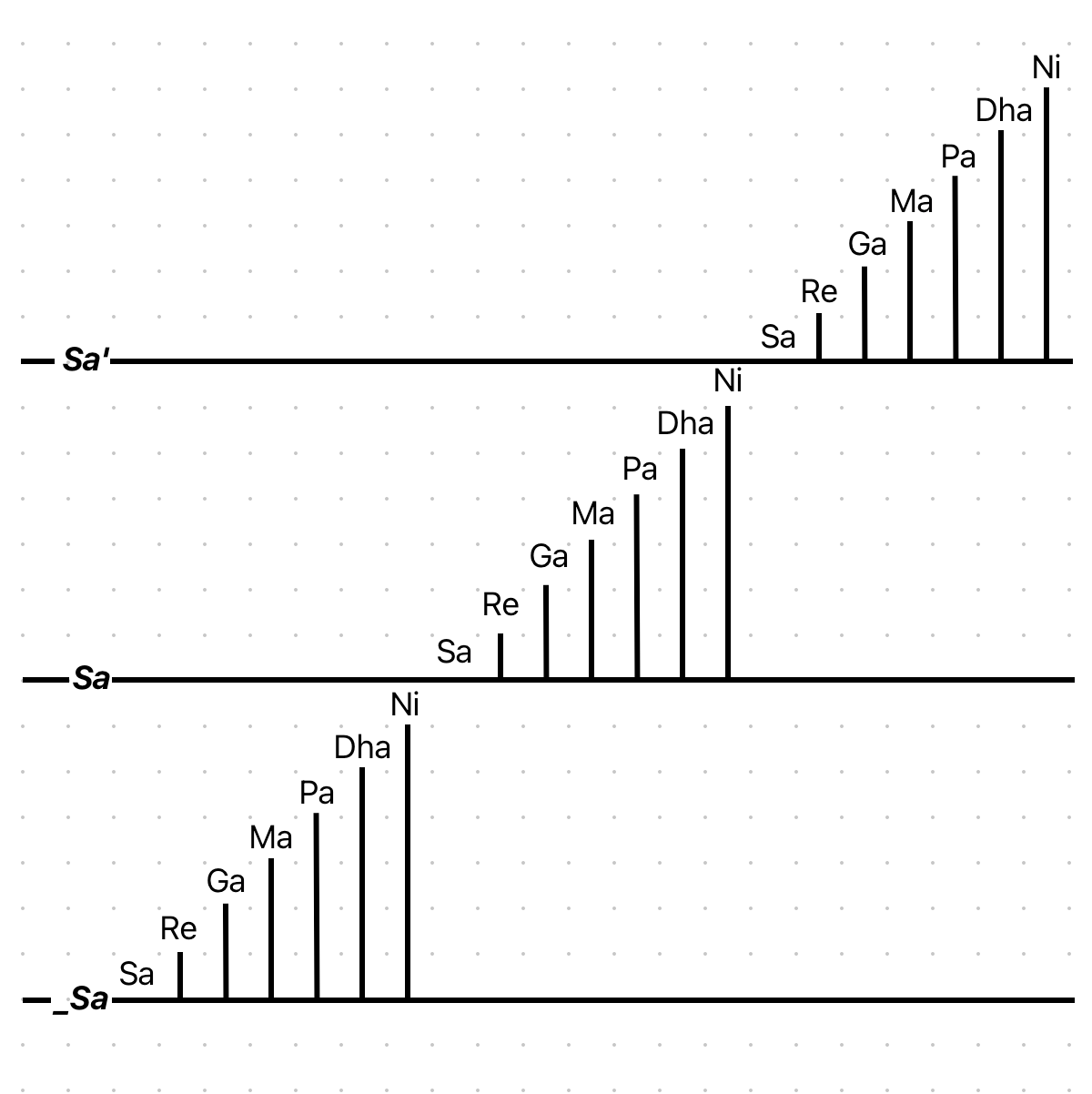
If the context is clear, we can refer to any octave-shifted version of a pitch by the name of the base pitch. So if we’re visually representing _Ga, we could just write Ga, since we can see that it’s between _Sa and Sa.
We do this mainly for the sake of convenience. With this change, our 3-octave dictionary would look less cluttered (notice the absence of octave markings in the names):
And this is how the earlier melody would be represented with this simplified scheme (once again, the octave marks in the pitch names have vanished):
Detour: Counting with 10
Let’s think about how we use the place-value system when counting numbers. We’ll connect it back to pitch in a bit.
How would we represent the number twenty-one? Counting in groups of 10 offers us a very quick way: two tens and a one. Therefore, it is: 21.
How about one hundred and fifteen? A hundred, a ten and a five. That means we’ll represent it as: 115.
When trying to conceptualise numbers, we don’t have to grudgingly plod our way to each number by counting up all the way from 1. That kind of repetitive effort would make the use of any large number a nightmare (maybe you already feel that way!).
In the world we live in, numbers can be arranged in patterns. These patterns help us move past the tedium of brute-force counting.
One such pattern is grouping numbers by powers of 10 (…, 1/100, 1/10, 1, 10, 100,…). We can use these like checkpoints on the number map to quickly understand the magnitude of any number.
What does any of this have to do with pitch?
Using Sa-Octaves as Yardsticks
An similar idea plays out in pitch. Sa-octaves are like powers of 10 — octave yardsticks on pitch.
In the same way that moving between powers of 10 (like 10 and 100) makes numbers easier to manage, shifting between the octaves of Sa (like Sa and Sa') makes recognising pitches much simpler.
On the other hand, comparing pitches with a single Sa makes it harder to recognise pitches that are very far from Sa (like Dha' or _Ma). It’s like thinking of 154 without using the concept of a hundred - possible, but tedious!
Let’s hear it in action. First, let’s listen to how Sa Ga would sound:
This is the interval of a Major Third that we’ve heard in Part 2.
Like counting up to a large number using just ones and tens, relating a high pitch to a single Sa involves needless effort.
This is how Sa Ga' would sound (notice that Ga' is pretty far from Sa):
This interval is much bigger than any interval in our 7-interval dictionary.
In such a situation, having a good grasp of different octave-versions of Sa really helps — we can quickly recognise any pitch by comparing it to the closest Sa.
Recognising Ga' is much easier when we have the closest octave of Sa (Sa') as a reference. This is how Sa' Ga' would sound (notice how much closer they are than the Sa Ga' combination above):
This interval is once again a Major Third. And we already know what that sounds like (from Part 2). No new intervals needed!
By familiarising ourselves with Sa-octaves, pitch recognition becomes so much simpler, since we don’t need to search for intervals outside our existing dictionary!
What’s Next?
We’ll move from the world of sight to sound, and try to decode the pitches of a few multi-octave melodies. This will give us a chance to practically apply what we’ve learnt about pitch and octave so far.
Also, with the next part, we will finally conclude the Pitch section of this series!
Next → Part 8: Hearing Octaves
Thanks for reading!
Do you love music? And learning? What’s that — oh — you’d like to discover some of the more intimate intricacies of music? Spoken like a true Friend of Music. Well then, there’s just one thing left to do: Subscribe, O Friend!