
Relating Pitches
Melody: Part 2

Here’s the melody we want to understand.
In Part 1, we discussed the importance of names. We also saw that when perceiving the pitch of a sound, we can name it in relation to other pitches. We made this concrete by considering two pitched sounds, T and U.
Here’s T:
Here’s U:
If you haven’t read Part 1, here it is:
Pitch becomes Picture
Let’s make pitch comparisons more palpable. For simplicity, we’ll call T’s pitch Sa and U’s pitch Ga. We can imagine our two pitches to be points on a vertical line. They’d look something like this:
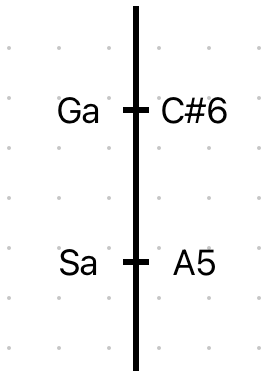
Why is Ga above Sa and not below it? That’s purely convention. As long as we remember to be consistent with our choice of direction and naming, it should work out alright.
If Sa and Ga had been marked at exactly the same point, that would mean that they’re the same pitch, which they are most certainly not!
Given that pitches can be ordered, I’m just choosing to follow convention by placing Ga above Sa. Feel free to do it another way.
Relative Pitch
What if I didn’t label the pitches themselves but only labelled the relationship (or interval) between them? In the case of Sa and Ga, their relationship would be called a Major Third (we’ll get into weeds of interval naming some other time).
Here’s the sound of a melodic (sequential) Major Third:
Here’s the sound of a harmonic (simultaneous) Major Third:
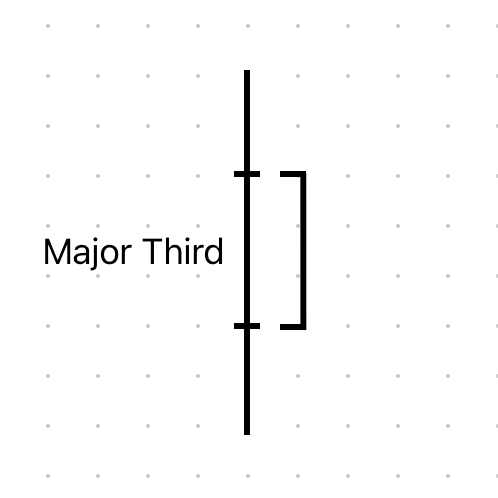
When I listen to a phrase, this is roughly how I perceive it—in terms of the intervals between its constituent pitches. This skill/phenomenon is called relative pitch.
Referential Relative Pitch
In the case of many musicians (including me), there is one crucial modification to the above: we begin by choosing a reference pitch and then perceive all other pitches in relation to this reference.
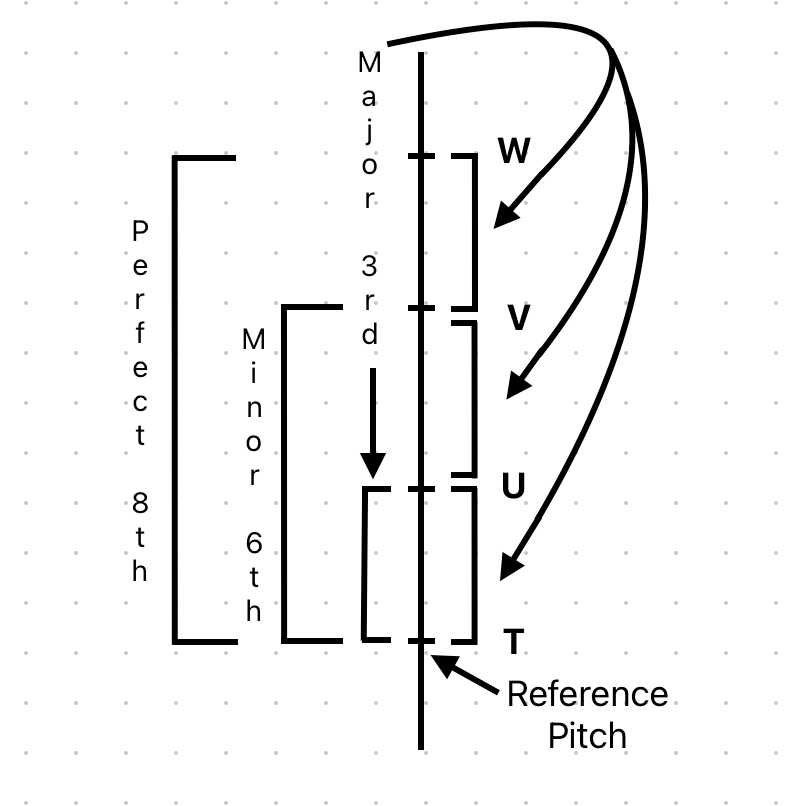
Let’s say I have 4 pitches: T, U, V and W. Here’s how they’re related:
T → Major Third → U
U → Major Third → V
V → Major Third → W
When referring to these four pitches, I would pick T as my reference pitch and relate every other pitch with it. If you’re curious to know these relationships as well, here they are:
When it comes to decoding the pitches in a phrase (the thing we’ve been building towards in the first place), instead of labelling relationships between each pair of adjacent (sequential/simultaneous) pitches,
I choose one reference pitch for the entire phrase,
I label all other pitches in the phrase in relation to this reference.
Line Relationships
If you’re not used to decoding pitch and/or the above description went way over your head, don’t worry. We’ll build up to it using pictures so you get an idea of how it might feel with sound.
First, look at these 6 lines:
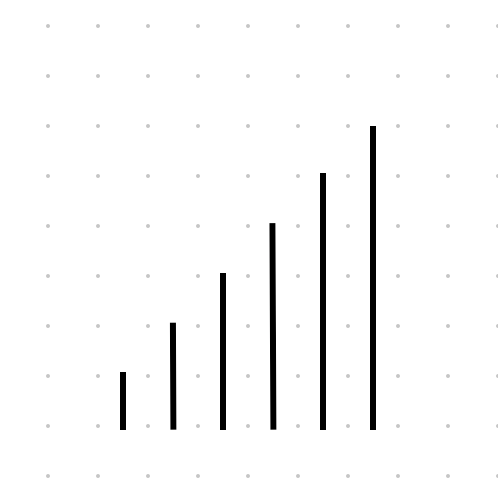
You stared way too long. Those lines are straight, you know.
Each line is of a different length. Let’s name them according to their lengths. So we have, 1, 2, 3, 4, 5, and 6.
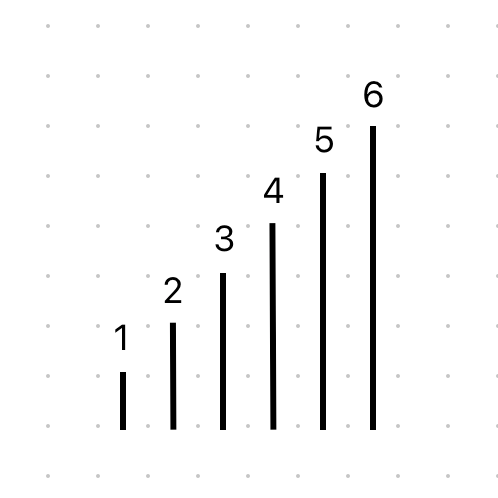
Size does matter. Now look at these points marked out below:
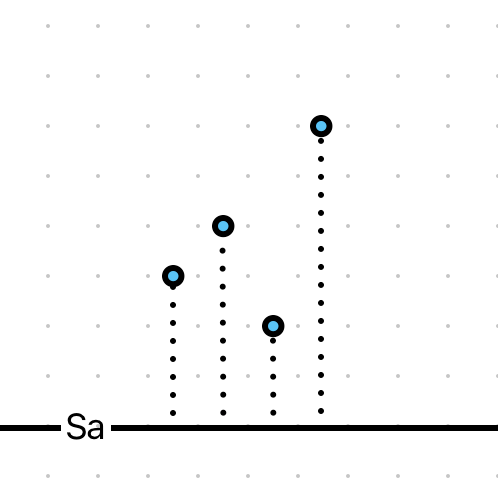
Each of them has a dotted vertical line connecting it to the solid horizontal line at the base. We’ll call the solid line at the base Sa. Think of each dotted line as a blank that we need to fill in.
What we have here is, in essence, a “phrase of 4 lines” waiting to be filled in with lines of the appropriate length.
Can you fit 4 of the 6 numbered lines from earlier into the right blanks?
If you do it just right like Goldilocks would, every point will end up joined to the baseline Sa by a line of just the right length.
Take as much time as you need. This will give you a feel for identifying pitches when listening to a musical phrase.
.
The
.
Answer
.
Is
.
Below.
Great job! Hopefully, this is what you got:
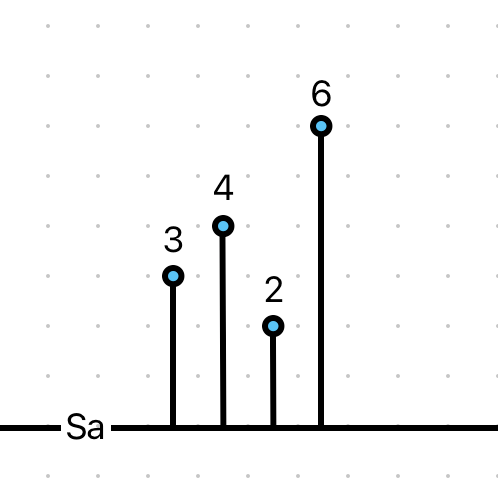
This is a visual analogy for how pitch can be decoded, given a musical phrase. We’ll develop this analogy in greater detail as we progress through this series but for now, here’s an interesting note to end on: maybe you already noticed, but you can also think of Sa in another way: as a vertical line with zero length. That makes it a great reference.
Let me know in the comments how this felt for you. Do you see how a similar process might work with pitches?
Next → Part 3: The Lines of Melody
Liked what you saw? There’s more on its way.
If you’d like to be part of a community that deeply engages with art and science simply for the joy of learning, then please consider subscribing to Sound Insight.
Fascinating read! I’m curious if it’s possible to visualize the harmonics in a pictorial form?
Great piece again 👏
One question though, how would Major third to Major third become Minor sixth?