
Doubly Symmetrical
Melody: Part 6

In this part of the Melody series, we’ll see how octaves connect to melodic contour or the “shape” of a melody. We’re nearing the end of our exploration of melodic pitch, so feel free to skim through the earlier parts for a refresher:
Experiencing Pitch Contour
Here’s our familiar melody once again:
How would it sound if we shifted every pitch in this melody up by the interval of a Major Third (the interval we encountered in Part 2?
What about shifting the original melody down by a Major Third?
Can you hear how the contour (or shape) of these three melodies is pretty much the same? They’re just pitch-shifted versions of each other.
Let’s make this visual. Here’s how we’ve been representing the melody so far:
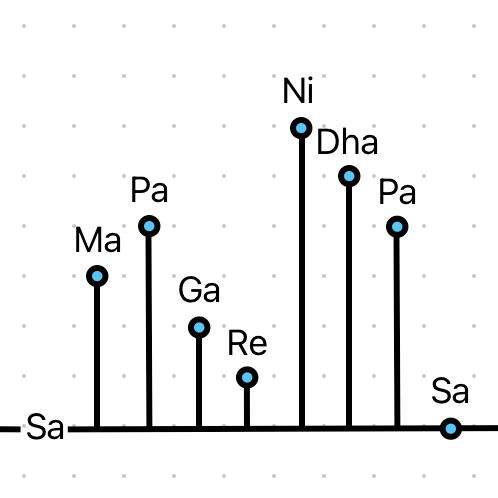
We can make its pitch contour explicit by removing the vertical lines and connecting the pitch points. This is how the three melodies that we just heard would look:
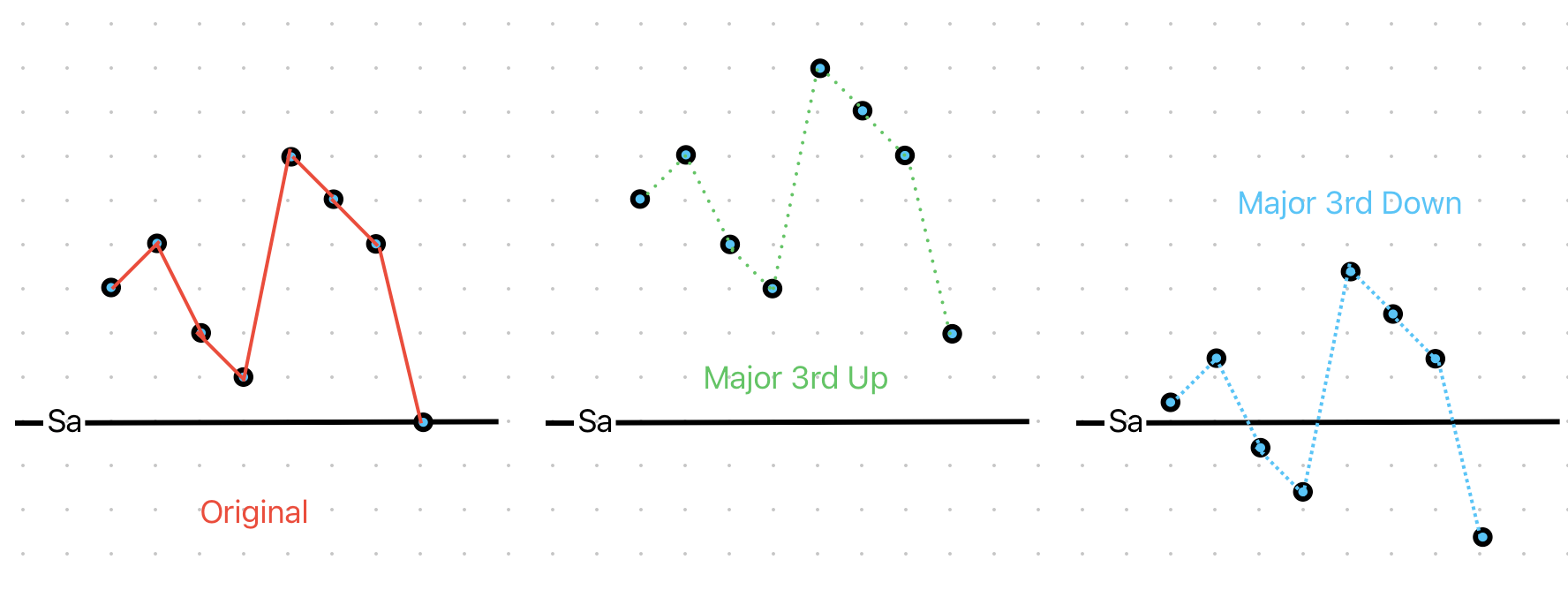
The contour of the original melody remains intact because we are uniformly shifting all its pitches by the same interval. This is what allows us to recognise these melodies as 3 different versions of the same melody.
In fact, if we overlay these three contours onto each other, we get just the one contour:
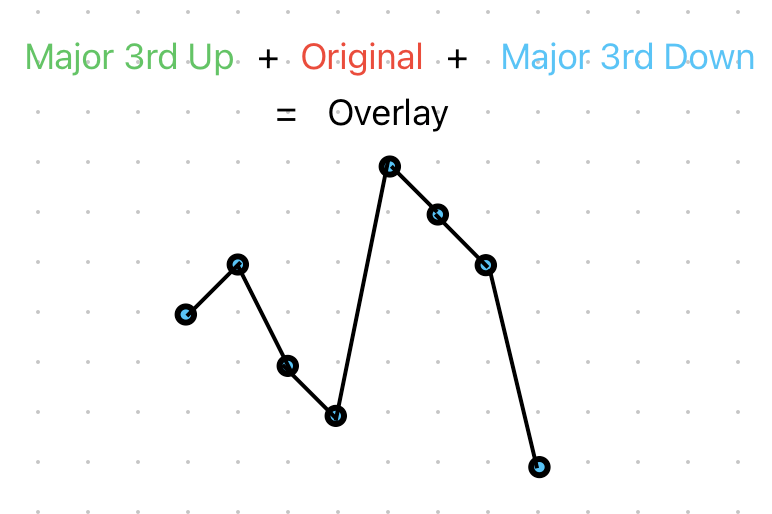
In fact, no matter which interval we use to shift pitches (up or down), the result is the same: the pitch contour of a melody remains the same with any uniform interval shift.
From the Top
More precisely, the front view contour remains the same with any interval shift. Does the top view (Part 5) contour remain the same as well?
Here is the top view of the very same melodies from above, along with their overlay:
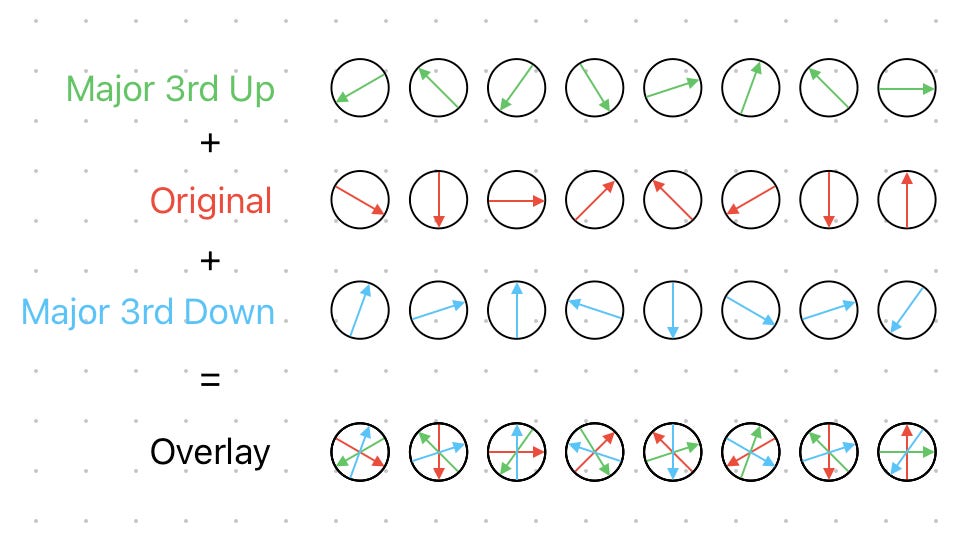
Clearly, that did not work out as neatly as in the front view. In the top view, these 3 melodies look nothing like each other.
So, while a Major Third interval leaves the contour of a melody unaffected in the front view, it distorts the contour in the top view.
Is there any interval shift that maintains the melody contour in both views?
There’s only one that does the job. Here it is:
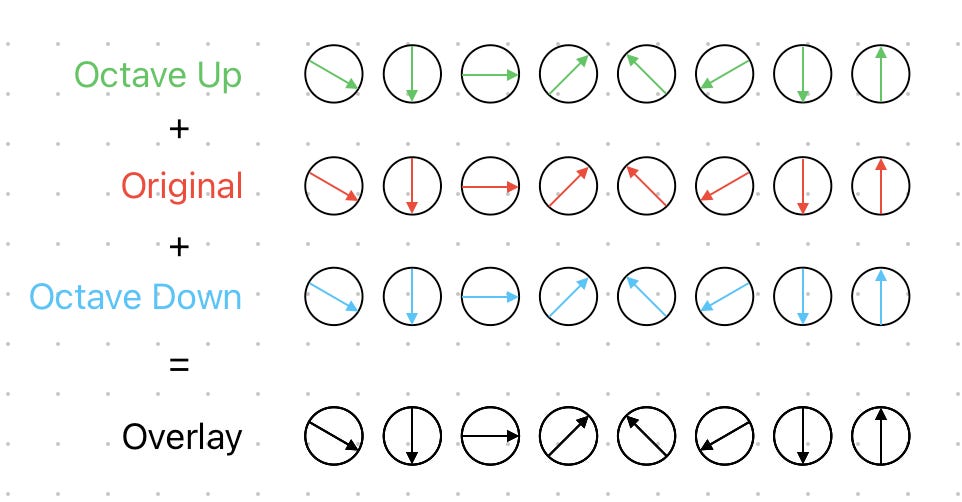
This interval is the octave, and the fact that it maintains the symmetry of any melody in the front view and top view is what makes it special.
In fact, any pitch shifted by one or more octaves, is symmetrical to the original pitch.
Octave Symmetry
In Part 5, we heard a few examples of octave-separated pitches, and (hopefully) it was clear how they combined seamlessly, like sugar dissolving in water.
Let’s try to make this explicit by combining octave-separated versions of entire melodies and listening to the overlaid result.
Here is the original melody along with its two octave-shifted versions:
Original:
Octave up:
Octave down:
If you compare these three melodies, you’ll notice that the melody retains its front view contour, just like it did with the Major Third shifts.
So far, the octave seems to have no edge over its rivals.
Let’s move over to the overlays now. First, we combine the original with its two Major Third shift versions. Then we create another combination, but this time using octaves: we combine the original with its two octave-shifted versions.
This puts us in a position to compare the two versions (Major Third shift and octave shift) with each other, and also with the original melody.
When you compare the cloudiness of the Major Third shifts…
…to the clarity of the octave-shift overlay…
…and the original melody,…
…it becomes easier to hear how the octave shift leaves the essence of the melody unchanged.
If we imagine a melody to be a glass of clear water, the Major Third overlay would be like adding equal quantities of butter and sesame oil to the water. You have triple the quantity, but the mixture is all cloudy.
The octave overlay, on the other hand, feels like adding ice and steam to the water. The water remains just as clear as it was before.
Extended Octaves
Now that we have experienced the natural symmetries that octaves lend to the pitch spectrum, we can use octaves to relate many pitches to each other in a very simple and systematic way. Here goes:
We know from Part 5 that an octave up from Sa is Sa'. Also, an octave down from Sa is _Sa.
We can extend this further.
Going 2 octaves up from Sa, we have Sa'' (2 apostrophes).
And 2 octaves down from Sa, we have __Sa (2 underscores).
The same applies to other pitches as well. For example, 2 octaves up from Re would Re'' and 1 octave down from Ma would be _Ma.
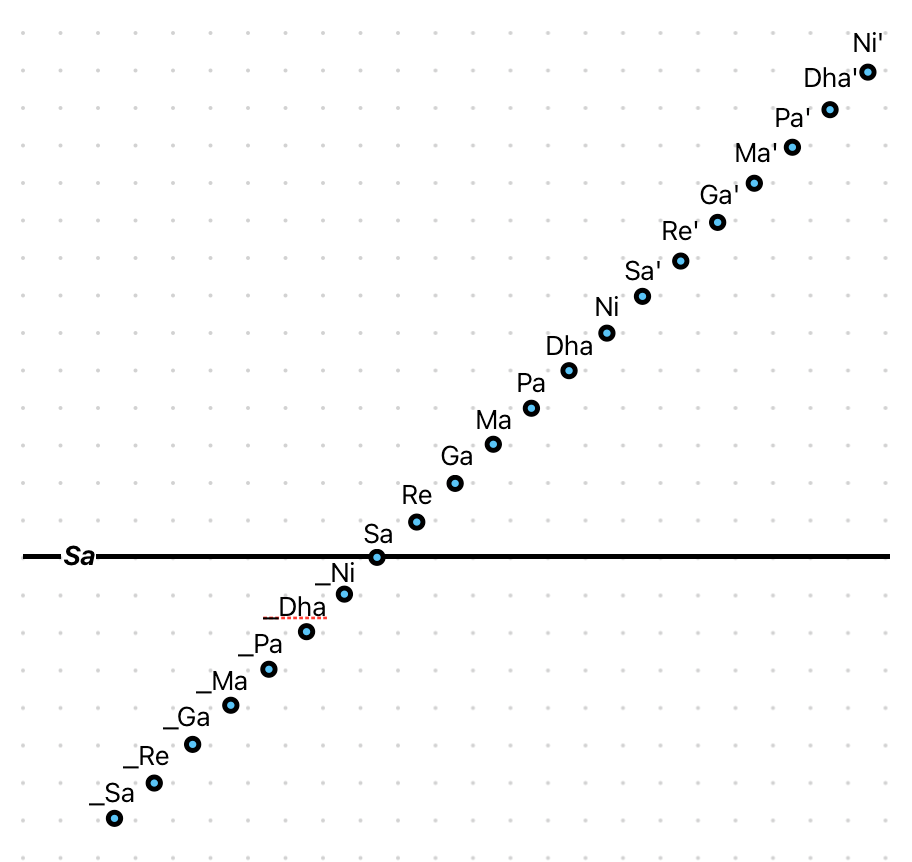
Just as we had related 6 pitches (Re-Ni) to Sa, we can relate all octave-shifted versions of a pitch to the base version of the pitch. For example, we can relate all octave-shifted versions of Pa, such as Pa' and __Pa, to Pa.
In general, starting with any base pitch, we add an apostrophe (') for each successive octave jump up, and an underscore (_) for every successive octave jump down.
What’s Next?
In the next part, we’ll simplify our current two-view visualisation of pitch by incorporating what we’ve learnt about octave symmetry.
Next → Part 7: Octave Yardsticks
Thanks for reading! There’s more on its way :)