
Naming Pitches
Melody: Part 1

Here’s the melody we want to understand.
A big part of what makes a melody memorable is the set of relationships shared by its elements. Understanding these relationships gives us a better understanding of the melody itself.
In order to get there, it would be helpful to identify all the elements. To keep track of what we identify, names are indispensable. Autocratic surveillance governments will agree with me on this one.
The Experience of Pitch
Let’s start simple. Here’s a sound. Let’s name this sound T:
Here’s a different sound. We’ll call this U:
I hope you can agree with me that these sounds are different from one another. What makes them different? Pitch.
Here are T and U one after the other (melody):
And here they are simultaneously (harmony):
What about two sounds that share the same pitch? Here’s how one U followed by another U would sound:
Identical.
Names Clarify Relationships
It’s safe to conclude that T and U have different pitches. Is it also possible to rank these pitches? Would it make sense to ask if U’s pitch is more or less than T’s pitch?
The short answer is yes. A longer answer is yes, certainly.
We’ll save the nuts and bolts of how that is done for another time. For now, all we need to know is that when people name pitches, those names are (almost always) based on an inherent ordering or ranking scheme. In some naming systems, the names even hint at the relationships between pitches.
A Rose By Any Other Name
Here’s one way to give names to our 2 pitches: The pitch of T is A5. The pitch of U is C#6 (pronounced C sharp six). In many contexts, we could simply call them A and C#. This is the system used largely in Eurocentric (Western) music.
Another set of names for T and U would be Sa and Ga respectively. That’s another common (and personally, less scary-looking) way of labelling them that is used mostly in the Indian subcontinent. There are other ways as well, and they each have their purpose.
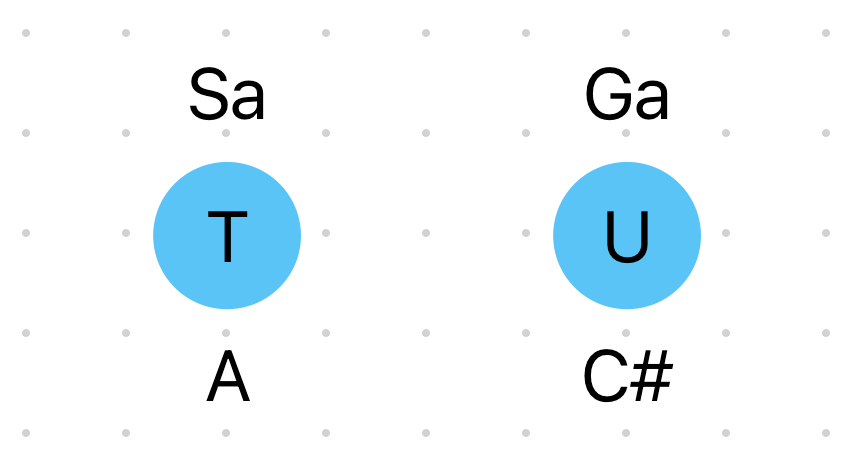
At the end of the day, they’re just names, like T, U, and the names you and your work-friends use on WhatsApp when pitching about your colleagues. Don’t worry. Your secret is safe with me.
Next → Part 2: Relating Pitches
Liked what you saw? There’s more on its way.
If you’d like to be part of a community that deeply engages with art and science simply for the joy of learning, then please consider subscribing to Sound Insight.
Expressed a basic that just opens up 'whys' of an art form. Incredible! Looking forward to more of this.
Awesome. Looking forward to the next parts of this series. :)