
Pitch Symmetry
Melody: Part 5

Here’s the melody we’ve been trying to decode:
So far, we’ve decoded its pitch (Part 3 of the Melody series: Ma Pa Ga Re Ni Dha Pa Sa). Before we figure out how these pitches are arranged in time, we need to talk about the octave. Not only does it generate far-reaching pitch symmetries but it also has wonderful analogues in rhythm!
Lines to Cylinders
Here’s our representation of the above melody from Part 3:
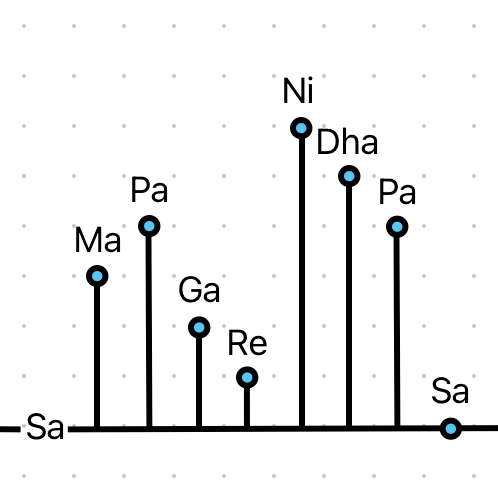
Let’s update this picture in a way that reveals a bit more about pitch. We’ll start by doing something a bit random: we’ll replace all the vertical lines by cylinders.
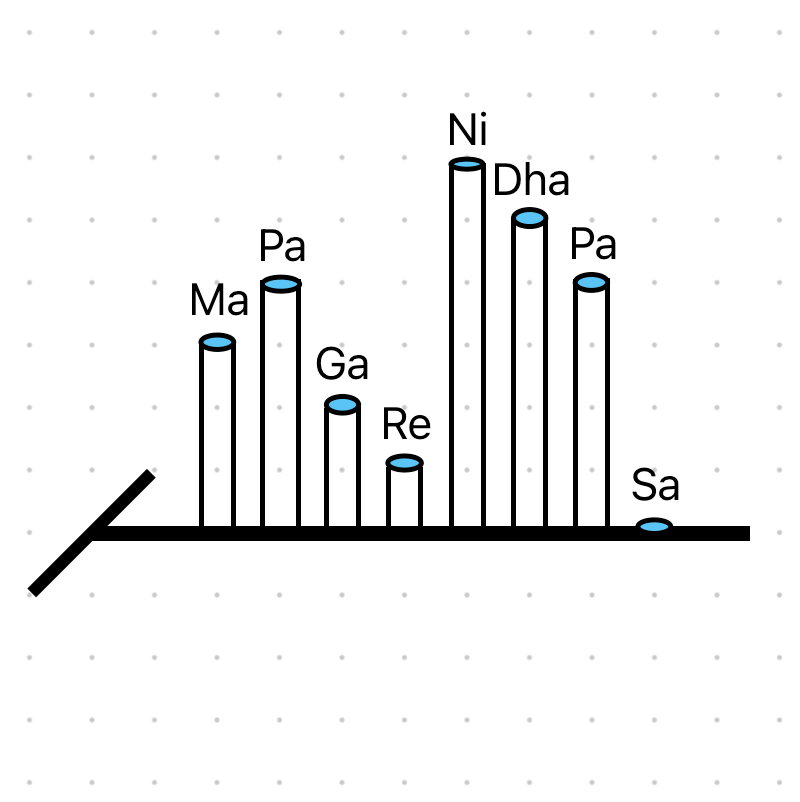
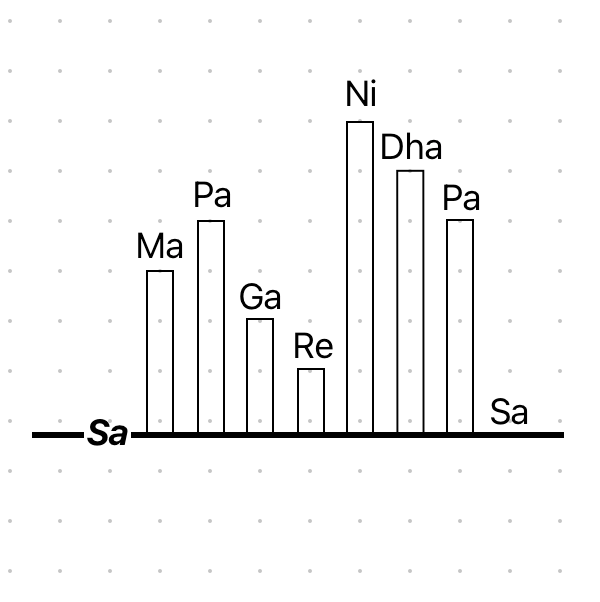
If we were to look at this from the front, it would look like a bunch of rectangular bars:
What about from above? Well, our melody cylinders turn into a bunch of little circles from that vantage point. Let’s zoom in a little so we can see them clearly:
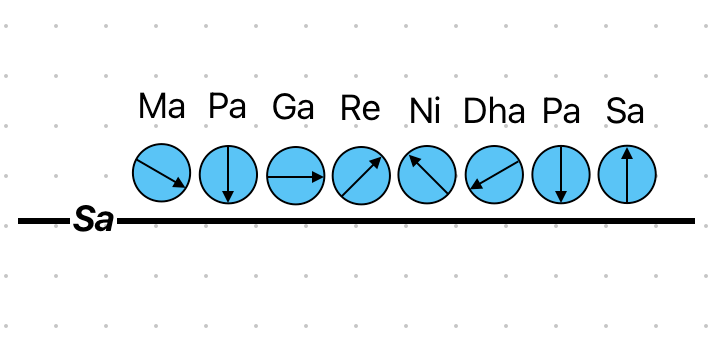
Ok. But what do the arrows within the circles mean?
Pitch Spiral
So far, we’ve thought of pitch as varying along a single axis or dimension. So one pitch is necessarily higher or lower than another. This allows us to use lines to represent intervals between any two pitches.
But what if pitch were more like a spring?
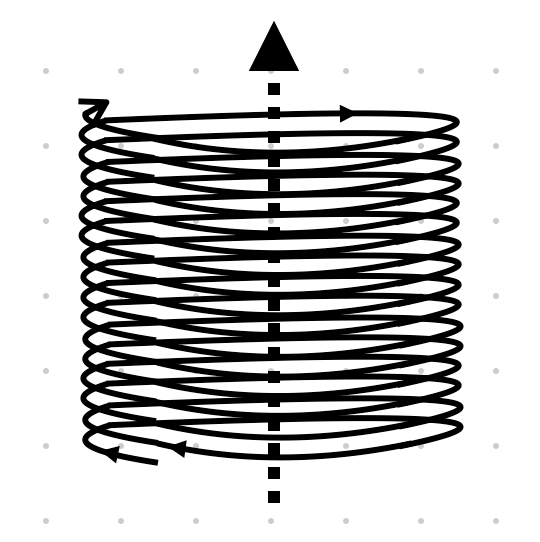
You could still move up or down to other pitches, but the only way to do that would be by moving along the filament of the spring.
So in addition to moving up or down, you’d be spiralling the entire way.
Our earlier pitch representations relied on a height difference from the baseline Sa. Now, they’ll include an angular (rotational) difference from Sa.
A View from the Top
It turns out that we were only using the front view in our 7-line dictionary from Part 3,:
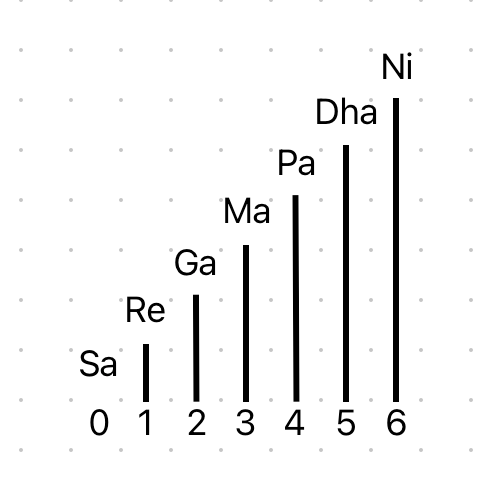
In this view, Sa is the reference pitch with zero height and each successive pitch is higher than the preceding one.
Let’s take a look at the top view of the same dictionary:
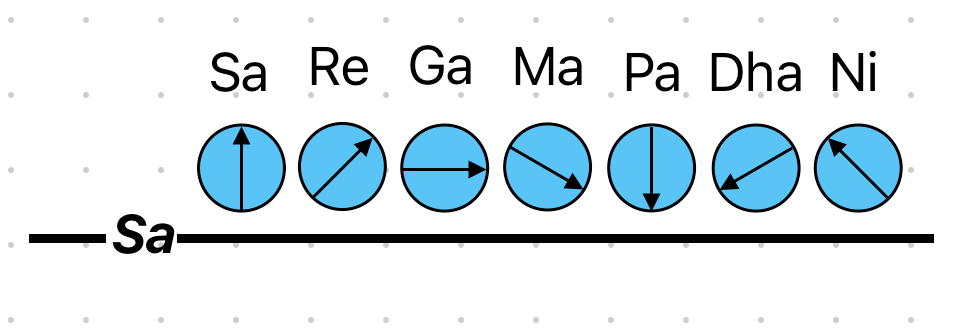
Distance in the front view has been replaced by angle in the top view. Each pitch is a small clockwise rotation away from the preceding one.
In our top view, Sa continues to be the reference pitch. We represent it by an arrow that points upwards at 12 o'clock.
Now in order to move from Sa to Re, we have to move clockwise up the spiral. This means that Re is not only higher than Sa, but also slightly rotated away from Sa.
Re is shown above as an arrow pointing halfway between 1 o'clock and 2 o'clock.
Next comes Ga, higher than Re and Sa, and rotated further than them — an arrow pointing at 3 o'clock.
Ma points at 4 o'clock
Pa points at 6 o'clock.
Dha points at 8 o'clock, and
Ni points between 10 o'clock and 11 o'clock.
The Octave Arrives
So what happens when we rotate further and return inevitably to 12 o'clock?
Rotationally speaking, we’ve come full circle, but we’re higher up than the last time we were here, so the pitch is definitely not Sa.
At the same time, there is something similar about this pitch and Sa, since they’re both pointing in the same direction.
How do we relate this pitch to Sa, without merging both identities?
Simple. We call this new pitch Sa' (the apostrophe ['] is intentional and a part of the name).
This interval — between Sa and Sa' — is called an octave.
Experiencing the Octave
Here’s our poetically-named sound from Part 1, T:
T’s pitch is Sa.
Here’s a sound whose pitch is an octave higher than Sa:
This is Sa',the pitch that we reach after travelling one entire loop up from Sa on the pitch spiral.
What about a sound whose pitch is an octave lower than Sa?
We’ll call this _Sa (the underscore [_] is intentional as well). This would be one loop down from Sa on the pitch spiral.
Let’s listen to a few combinations of these octave-separated pitches. Notice how these pitches merge beautifully with each other, like sugar with water.
Sa followed by Sa':
_Sa followed by Sa’:
Sa and Sa’ simultaneously:
Sa and _Sa simultaneously:
_Sa and Sa’ simultaneously:
What’s Next?
This interval holds such a special place in music because of the beautiful symmetries it generates. In the next part of the series, we’ll explore more of these as they apply to decoding melody. See you there!
Next → Part 6: Doubly Symmetrical
Liked what you saw? There’s more on its way.