
Fly Birdie, Fly
Melody: Part 31

The Final, Final Stretch
Here we are at last, at the very end of the Melody series. Let’s dive into the visual representations of our 2 remaining melodies, and then take a quick look at the main lessons we can draw from the entire series.
Melody 4
Pehla Nasha (approx. 0:47-1:00 of linked video), Jatin-Lalit:
Reference audio:
Pitch:
Sa Sa Sa, Ni_ Sa Pa Sa Ni_,
Sa Sa Sa, Ni_ Sa Pa Sa Ni_,
Dha_ Dha_ Dha_, Dha_ Ni_ Sa Ga Sa,
Sa Re Re Re,
Pa_ Sa Re Ga Re Sa Ni_ Sa.
Time:
TaMi Ta, aKaDiMi iKaMi,
TaMi Ta, aKaDiMi iKaMi,
TaMi Ta, aMi TaKaDiMi,
TaKaMi Ta,
aKaDiMi TaKaDiMi TaT.
Loudness:
Ha Ya Ha, Ya Ya Ya Ya Ya,
Ha Ya Ha, Ya Ya Ya Ya Ya,
Ha Ya Ha, Ya Ya Ya Ya Ya,
Ha Ha Ya Ha,
Ya Ya Ya Ya Ya Ya Ya Ha.
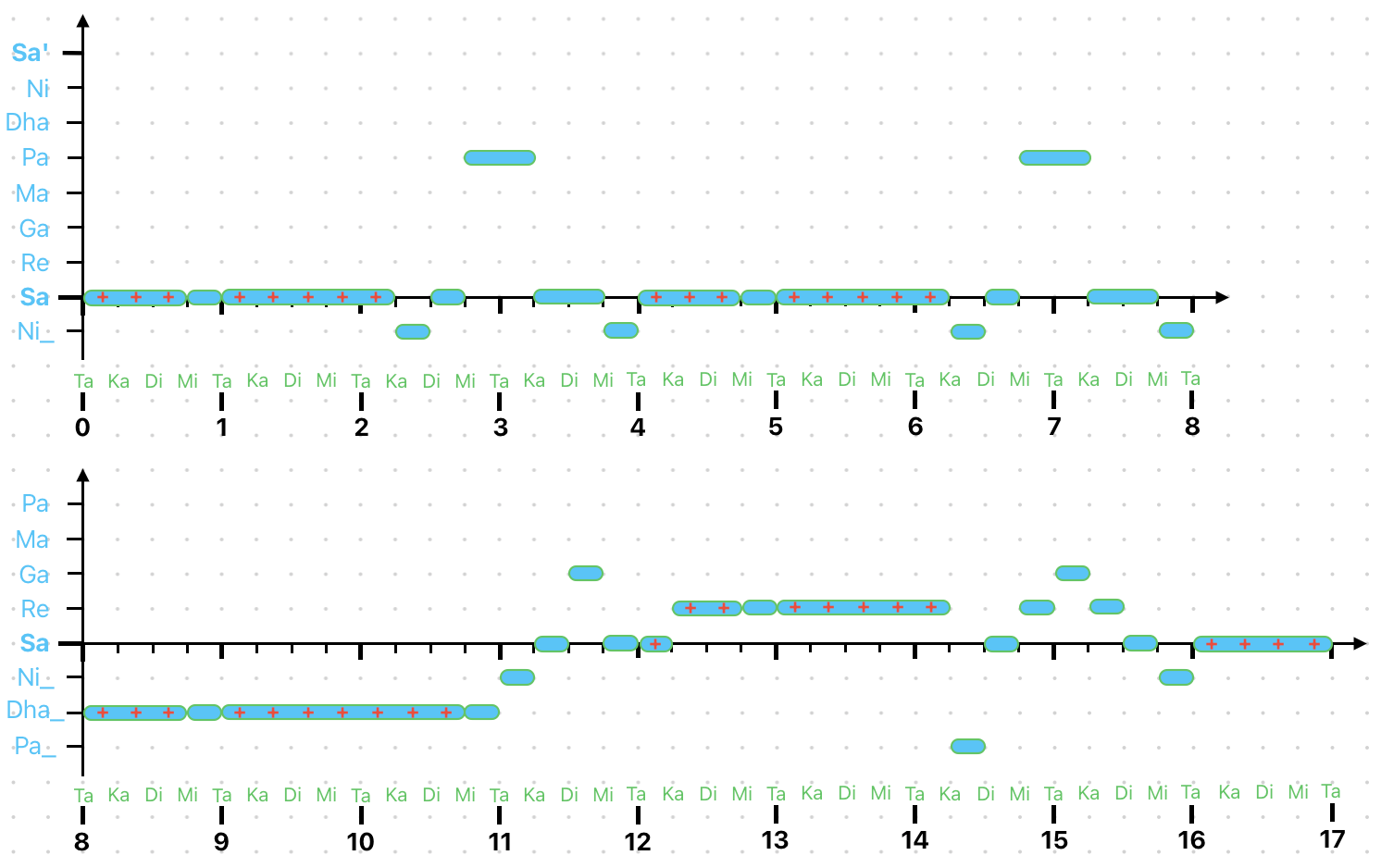
Visual representation (in 2 sections, spanning beats 0-8 and 8-17):
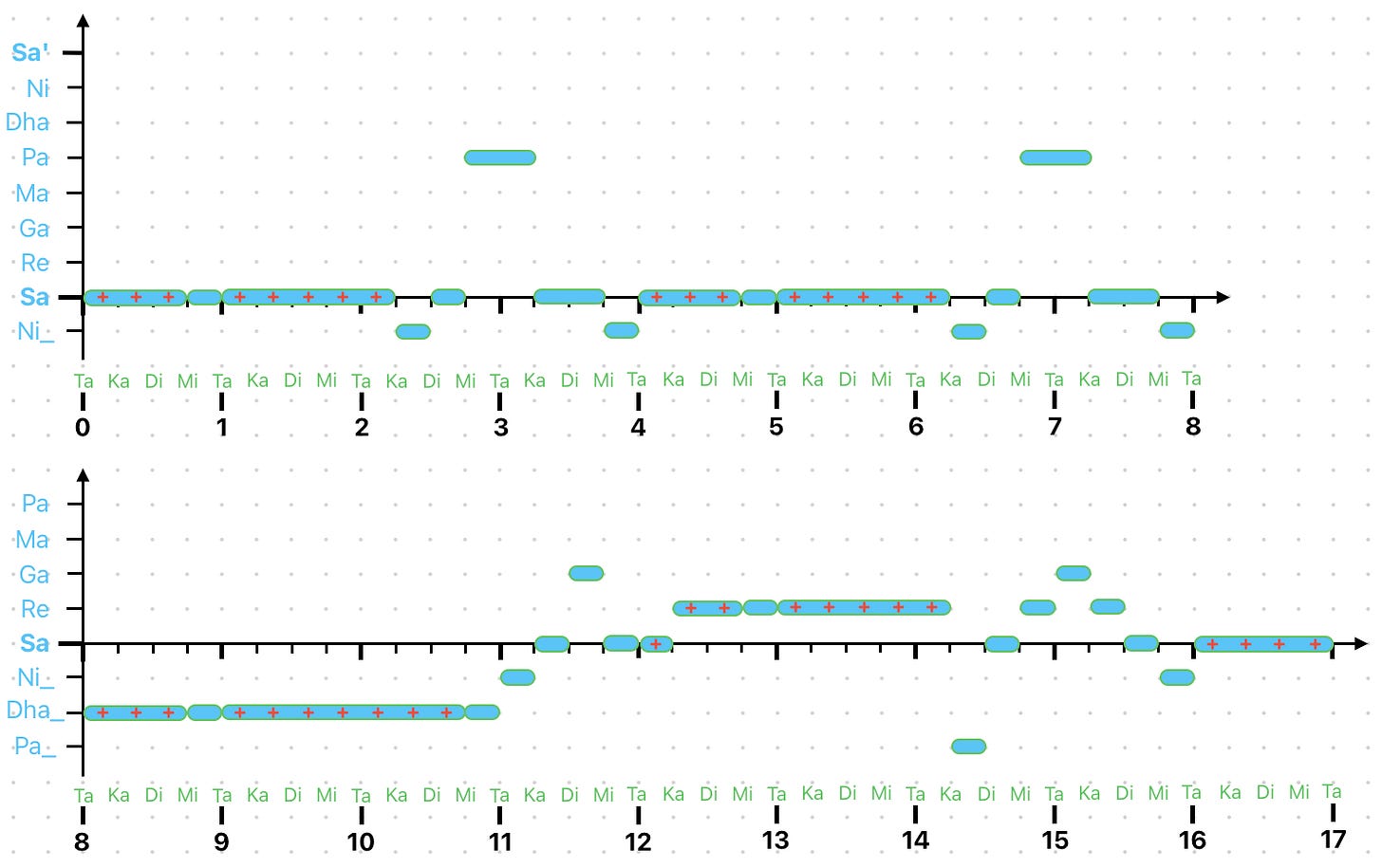
Pehla Nasha, visualised
Melody 5
Mamma Mia (approx. 1:03-1:20 of linked video), ABBA:
Reference audio:
Pitch:
Sa, Pa Pa Pa Pa, Re Ga Ma,
Dha_, Ga Ga Ga Ga, Ni_ Sa Re,
Ma_, Re Sa, Ma Ma Ga Sa Re Sa Re Sa,
Sa Sa Re Sa, Sa' Ni Dha,
Sa Sa Re Ga Re Sa,
Ma_, Re Sa, Ma Ma Ga Sa, Re Sa Re Sa.
Time:
Ta, Di iKaDiMi, iKaMi iKa,
Ta, Di iKaDiMi, iKaMi iKa,
Ta, Di Ta, Mi iKaDiMi TaKaDiMi,
iDiMi TaKa, DiMi Ta,
DiMi TaKaDiMi,
Ta, Di Ta, Mi iKaDiMi, TaKaDiMi.
Loudness:
Ya, Ha Ha Ha, Ha Ha Ha Ha,
Ya, Ha Ha Ha, Ha Ha Ha Ha,
Ya, Ha Ha, Ya Ya Ya Ya Ya Ya Ya Ya,
Ha Ha Ha Ha, Ve Ve Ve,
Ha Ha Ha Ha Ha Ha,
Ya, Ha Ha, Ha Ha Ha Ha, Ha Ha Ha Ha.
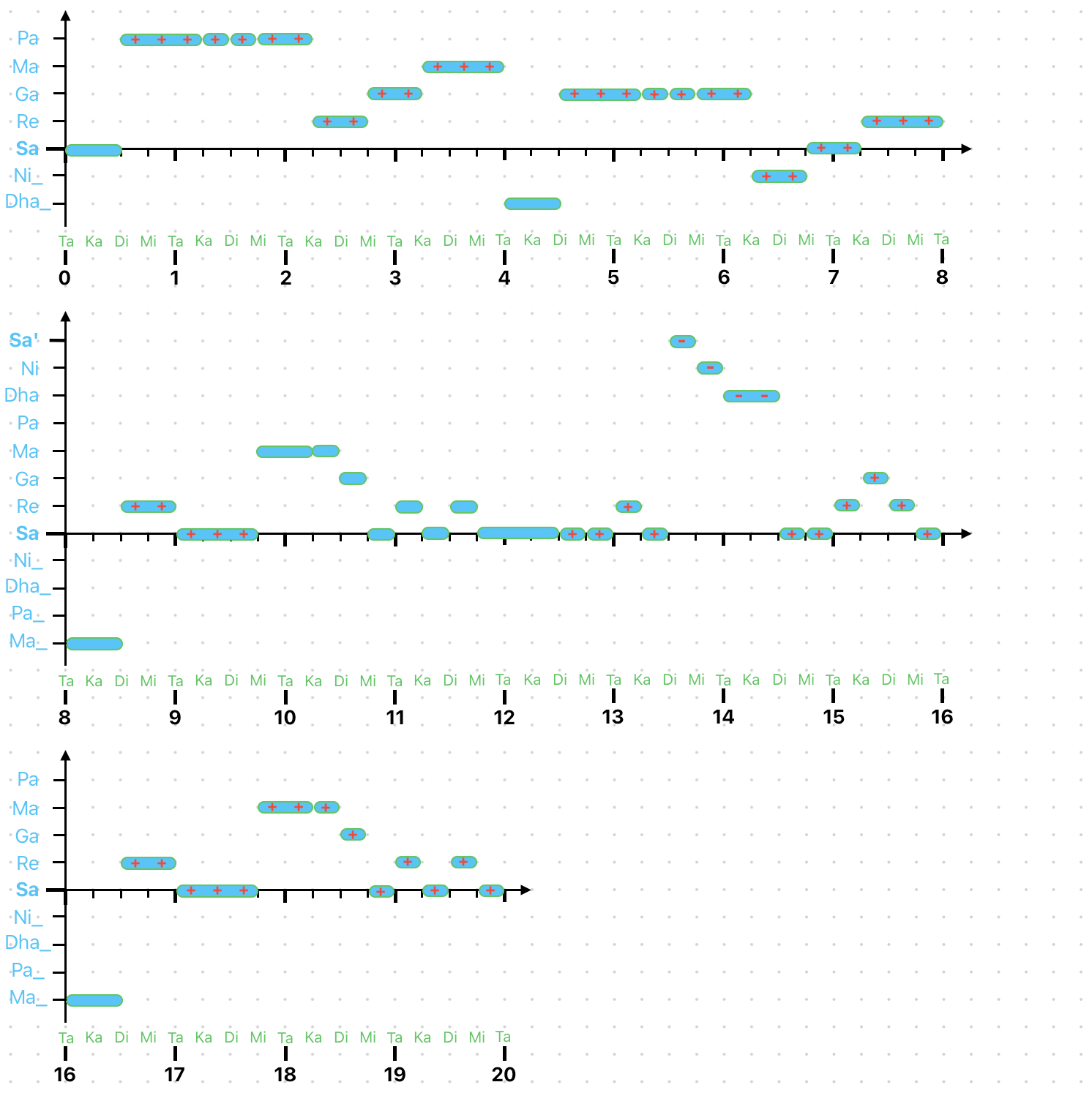
Visual representation (in 3 sections, spanning beats 0-8, 8-16 and 16-20):
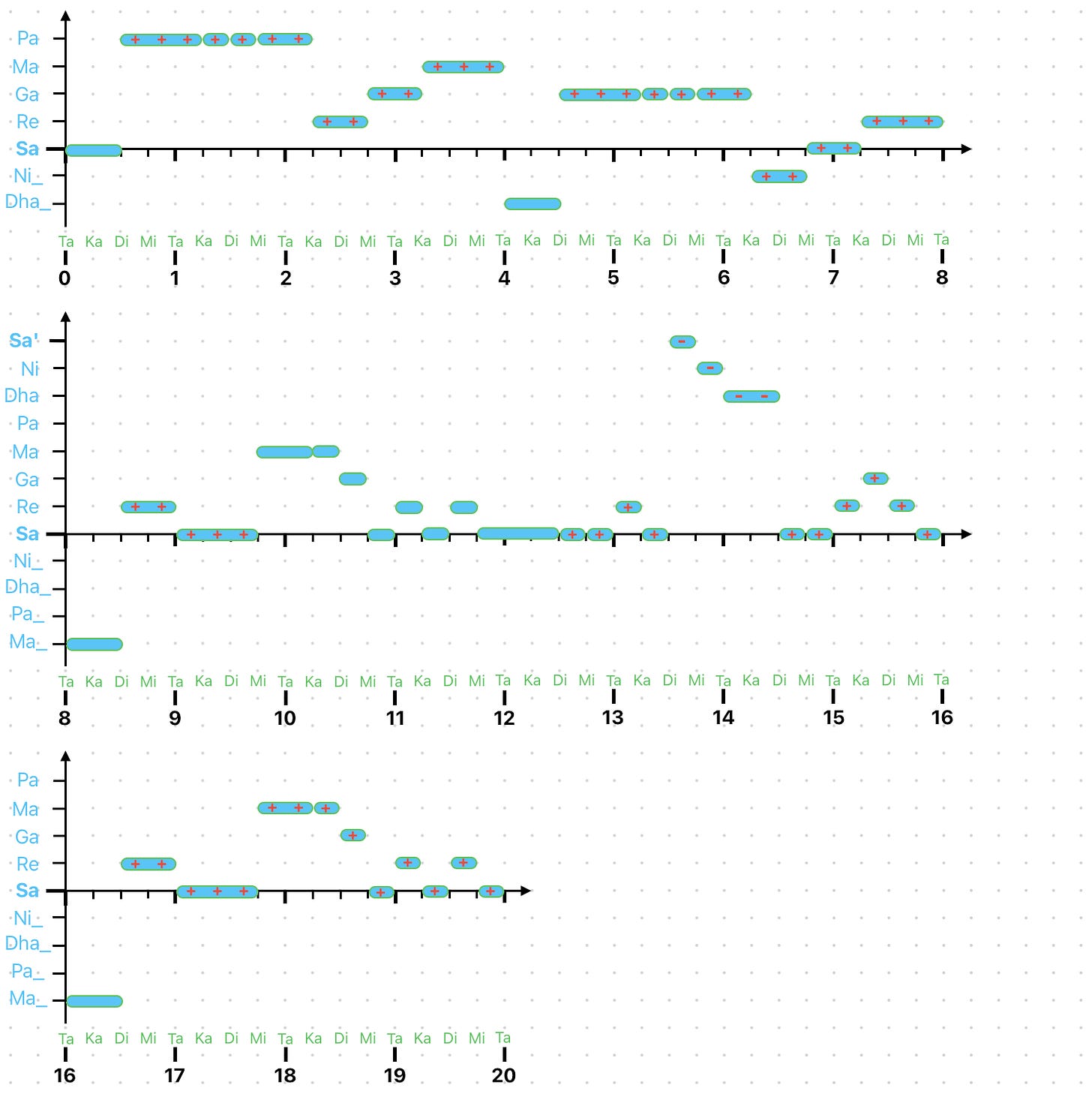
Mamma Mia, visualised
The Melody Series in a Fairly Big Nutshell
We’ve looked at and listened to 3 elements of melody:
Our working example through most of the series was The Melody, created purely for study and dissection. We separated its 3 melodic layers and then brought them all back together in the form of a unified visual representation.
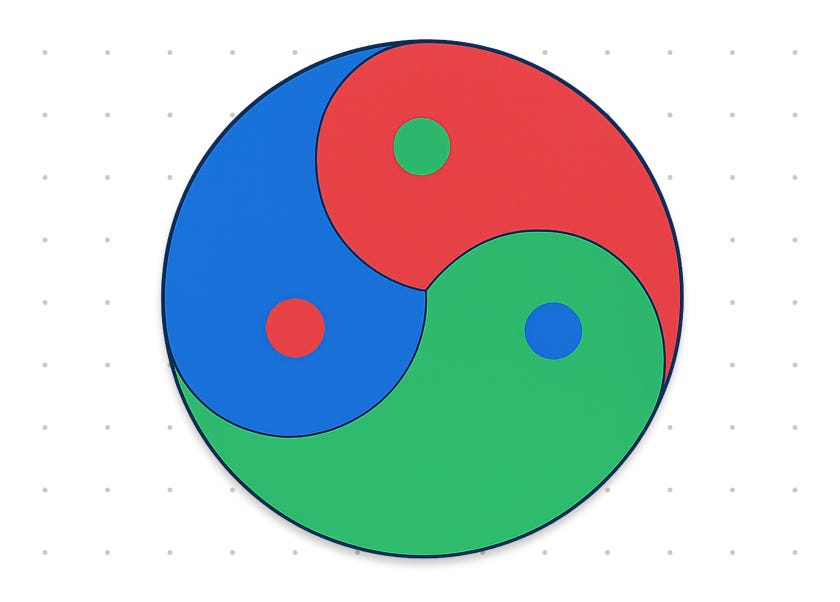
Each melodic element is a continuous spectrum, within which values can be increased or decreased:
Pitch: Lower or Higher
Time:
Loudness: Softer or Louder
We chose reference values within the spectrum of each element:
We related any other values of interest within each element to the reference to create element dictionaries:
We found (or simulated) symmetries within the 3 elements:
Time: Tempo-beats
Loudness: Spans (simulated)
With these symmetries, we could create a set of repeating references:
Pitch: …, Sa___, Sa__, Sa_, Sa, Sa', Sa'', Sa''', …
Time: 0, 1, 2, 3, …
Loudness: Ve, Ya, Ha
This gave us repeating sets of the initial dictionaries as well:
Pitch: Ni__, Ma''', Ga_ etc.
Time: Ka in beat 4, Mi in beat 22 etc.
Loudness: Loudness between Ya and Ha rounded off to the closest value etc.
In addition, we looked at a few special cases:
naming durations spanning multiple beats: Ta aMi, Di i iTa etc.
naming durations at the end of the melody: TaT, DiM etc.
the relationship between pitch and tempo: a high enough tempo can be perceived as pitch, and a low enough pitch can be perceived as tempo.
To hone our skill in recognising and conceptualising melodic values by ear, we attempted a few element-specific audio challenges:
Single-octave pitch recognition
Multi-octave pitch recognition
Beat recognition
Extended-duration beat recognition
Loudness recognition
With so many skills in the bag, it was time to play with them in the sandbox of audio:
We compared our listening and looking abilities with 5 audio-visual challenges.
We walked through the entire process of decoding a melody by ear, with the help of a children’s rhyme.
Finally, we brought together all the skills we had acquired, by:
taking apart snippets of 5 existing, publicly available melodies and segregating them into 3 layers:
pitch
rhythm
loudness
putting the layers back together into an integrated visual representation for each melody.
And now, here we are.
Where Do We Go Now?
There is an entire world of music out there, waiting to be absorbed, appreciated and expressed.
As we develop our skill in comprehending musical patterns, we will slowly and steadily acquire a musical vocabulary, much like we do when learning a language.
The hope is that the journey undertaken teaches them (you and I) how and where to focus their attention, so that they may eventually deepen their appreciation of music and the routes that other musicians have taken.
This series is intended as a first signpost, pointing musical travellers in the direction of some of the more obvious perceptual elements of music: melody and its 3 elements.
In the course of this journey, if they discover aspects of their musical selves, all the better.
The plan is to have this series serve as a springboard into future musical explorations on Sound Insight.
Since you are such an important part of this process, I’d be super grateful if you could share your experience of navigating this series (and Sound Insight in general), so that we can make it that much better for future travellers.
There’s a lot more on its way, so stay tuned!
But — if you’re hungry for more right this instant, here’s a melody for your decoding pleasure. No hints, no solutions.
Here it is:
Thank you!
You’ve been a fantastic companion on this journey, and I couldn’t be more grateful for such great company. The only thing that could top this would be to go on another music-filled adventure with you :D
We’ve explored some of the perceptual foundations of pitch, time and loudness, both through sound and sight, and seen how these elements come together to give us this enchanting experience we call melody.
There’s a lot more ground to be covered within the world of melody itself, not to mention music as a whole, and we’ll eventually explore many of these aspects too. All in good time!
I hope you’re ready for what’s coming up. And this time, I will do my best to keep it under 30 parts :P
Long Road Behind, Longer Ahead
Ah! Time for us to stretch our legs and wind down after what has been a long, and hopefully rewarding, climb into the lair of melody…
Whenever you’re ready, the next musical adventure awaits. :)
Do you love music? And learning? Well, then Sound Insight is the place for you!
If you’d like to spread what you’ve learnt (and support me along the way ;D), please consider sharing this post.
If you’d like to learn more, please reach out through comments/DMs. I’d love to learn from you as well :)