
Mirroring Symmetry
Melody: Part 20

Here’s The Melody:
We’re trying to decode its loudness pattern. It’ll be helpful to first see if loudness has any symmetries hidden within it, in the way pitch and time do.
Calibrate Your Device’s Volume
Before we begin, let’s calibrate our device volumes. Listen to the following sound:
Set your device volume to a level where you can clearly hear this sound without it being painful or uncomfortable.
Listen to all the audio examples that follow at the device volume that you’ve just set.
Symmetry
Let’s compare two versions of a different melody. Here’s the original version:
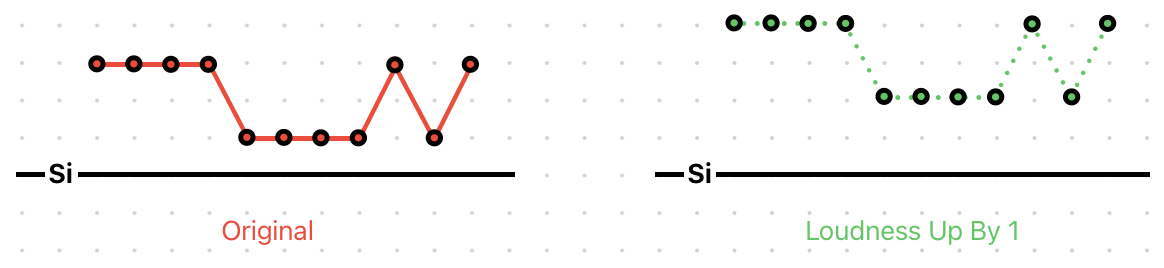
And here’s a modified version, with the same pitch contour and beat contour as before, but with the loudness of every pitch increased by a range of 1 (from our range dictionary):
The only difference between these two melodies is the loudness of the pitches. This is how their loudness contours compare:
If we overlay these contours, here’s what we get:
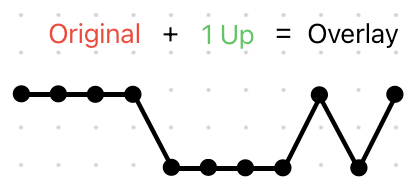
So if we think of the above picture as the loudness front view, similar to the pitch front view (Part 6) and the time front view (Part 16), we can see that the loudness contour remains unchanged.
The pitches in the second melody are uniformly louder than their counterparts in the first melody. In the front view, any uniform range shift is a symmetrical shift.
Another Spiral?
Is there another view, like the pitch top view (Part 6), or the beat side view (Part 16), where this symmetry breaks?
And is there something equivalent to Sa-octaves (Part 7) or tempo-beats (Part 16) in loudness, which can be used to maintain contour symmetry in all views?
At the root of it all, the question we’re asking is: does there exist a loudness spiral to give company to the pitch spiral (Part 5) and beat spiral (Part 15) from earlier?
Well, no.1
Phew. Things got a lot simpler. Right?
Something from Nothing
Wrong! Let’s make life harder by celebrating the masochist living within us.
While we may not have perceptual equivalents of Sa-octaves and tempo-beats in loudness, nothing is stopping us from making them up as we go.
“But why?!” you might ask in a fit of anguished confusion. Believe it or not, we’re doing this to simplify our loudness system in the longer run. Hang in there!
Earlier in the Melody series, we grouped 7 pitches (Sa, Re, Ga, Ma Pa, Dha and Ni) into groups, with each pitch group referenced by a specific Sa-octave.
We also grouped inner beats (Ta, Ka, Di and Mi) into groups, with each beat group referenced by a tempo-beat.
So, in line with what we’ve done with pitch and time, let’s coalesce smaller loudness entities into larger groups, with each group having a reference loudness level.
We have 3 loudness levels in our loudness dictionary. Let’s put them in a group, and then use a shifted version the entire group. This will give us groups of progressively higher loudness levels.
We’ll call each of these groups a span.
Now, each span also needs a reference loudness level. We’ll make the lowest loudness level of each span its reference.
With 3 spans, our loudness dictionary becomes:
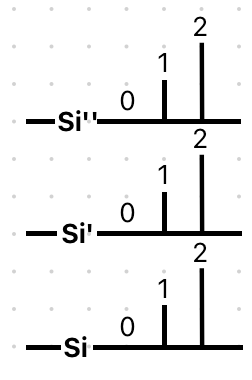
Since Si is the lowest loudness of the lowest group, we’ll call the references Si-spans (similar to Sa-octaves). Each Si-span has one apostrophe (') more than the one preceding it (Si, Si', Si'',…).
Is Silence a Good Reference?
Silence is great as an absolute reference for loudness. But relatively speaking, it might not always be the best choice when decoding a melody.
What makes Si unique is that, unlike any other level of loudness, its value of zero loudness makes it qualitatively different.
In terms of our perception, any level of loudness other than silence implies a sound. Silence, though, implies the absence of any sound.
What about the references we’ve used for pitch and time? Are they enigmatic in the way Si is?
Not really. Sa is just another pitch and Sam is just another beat. They don’t denote the presence or absence of sound the way Si does.
This makes Si somewhat of an (unavoidable) outsider to melody.
Seeing how silence is complementary to sound in this way, we might be better off using a loudness reference that doesn’t vanish with the presence of sound.
If we can do this, we’ll be able to neatly tie together pitch, time and loudness in one relative referential system that we can adjust based on the melody!
What’s Next?
We’ll remodel what we’ve constructed to get closer to the process of decoding loudness in practice. We’ll also change our reference to something relatively convenient.
Do you love music? And learning? If you’d like to discover some of the more intimate intricacies of music and support me along the way, please consider subscribing. I’d love to learn from you as well!
I’ve been looking, but so far, I haven’t found any specific range that exposes an underlying symmetry in loudness beyond what we’ve already seen.