
Tempo
Melody: Part 9

Music, like other performing arts, is embedded in time. Consequently, the pitches (and other elements) of a melody are arranged in the bedrock of time in some specific pattern.
Loosely speaking, this timing arrangement is called a rhythm, and figuring out a melody’s rhythm is as important as figuring out its pitches.
We’ve figured out the pitches of The Melody (Melodic Pitch), so now we’ll try our hand at figuring out its rhythm.
In order to do this well, the first and most foundational rhythmic skill we’ll need is: maintaining a tempo.
The Experience of Tempo
Here is a set of sequential sounds:
We’ll call this V. There is a certain time-pattern to V, which we can embody by clapping or tapping along with the sounds. Give it a go!
How well were you able to match the timing of your claps/taps with the sounds of V?
Here’s another set of sounds:
Let’s call this W. We can clap or tap along with W as well. Go ahead and try it out.
Do you feel that there’s something different about this pattern compared to the last one? Listen to (and follow along with) both of them to get a better idea of how they’re different from one another.
What makes V and W different from each other? Tempo.
Here are V and W in sequence:
You can perceive a change in the middle, when the tempo changes.
Here are V and W simultaneously:
Sounds a bit chaotic right? (Why do you think that happens?)
What if we had two sets of sounds with the same tempo? Here’s how one V followed by another V would sound:
The tempo remains unchanged throughout.
Beat It
The above examples should make it clear that we can compare one tempo with another.
Just as one pitch can be higher or lower than another pitch, one tempo can be faster or slower than another.
In our example with V and W, which one do you think has the faster tempo?
If it isn’t obvious, that’s not a problem. We’ll figure it out together.
It’ll help to focus on the individual sounds or beats of V and see how they’re related in terms of time. So, what’s a beat?
If time is a line, beats are like points on this line.
Each individual sound in V and W above can be considered a beat. A heartbeat is a beat. So is the ticking of a clock. Roughly speaking, a beat is any event that marks out an instant in time.
Establishing Tempo
One (very useful) way to arrange a sequence of beats involves keeping the time between every pair of successive beats exactly the same. Visually:
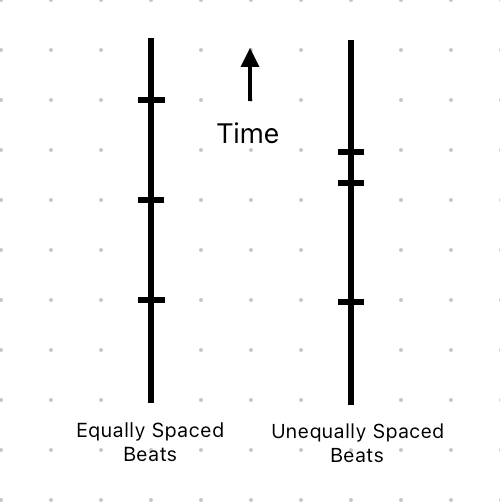
When we do this, we establish a tempo1.
This is why clapping along with V and W feels so steady. The regularly-paced sounds within V (or W) establish an even tempo, and following along with them gives us (or at the very least, me) a feeling of evenness as well.2
Tempo is the rhythmic equivalent of an unchanging pitch. And just as we relate all pitches to a reference Sa, we can relate all timing relationships to a reference tempo.
Sa gives us a way to be precise with our pitch perception, and tempo gives us a way to be precise with our perception of time. The more stable these references are, the more confident we can be about our musical perception.
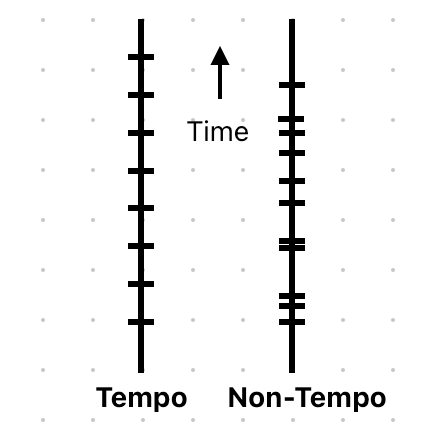
For example, here is a rhythm sequence that establishes tempo quite well (this is just W from above):
It’s easy to predict when we’ll hear the next beat.
Here’s one that miserably fails at setting up a tempo:
Gunfire like this makes it much harder to predict when the next beat will be heard. Visually, you can see how one has evenly spaced beats and the other doesn’t:
Ranking Tempo
At a faster tempo, the time between beats is less. Conversely, at a slower tempo, the time between beats is more. Let’s put this in visual terms:
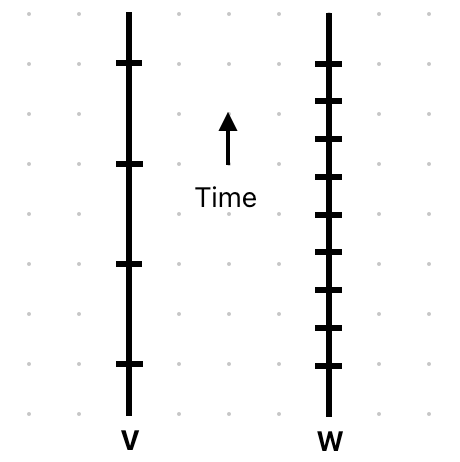
Going back to the question we asked a while back: which has the faster tempo — V or W?
If you thought W, you’re right!
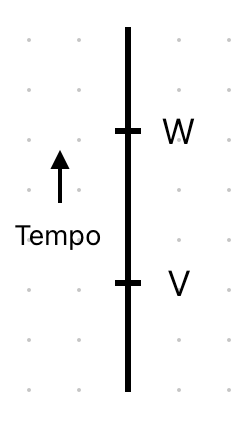
Now that we know this, let’s try to represent tempo in a simpler way. We’ll zoom out from the individual beats back to the overall tempo and represent it as a single point on a vertical line (like we did with pitch in Part 2).
A faster tempo would be higher up on the line, and of course, a slower tempo would be lower on the line.
Tempo of The Melody
Here’s our cherished melody (Part 1) once again:
If we clap each time a new pitch is heard (one clap per pitch), what kind of rhythm do we get? Have a listen:
Compare the melody with its clap-equivalent to convince yourself that they both share the same rhythm.
So — are all the claps evenly spaced in time?
If they are, perfect! Then this becomes our tempo. This would also mean that we’ve inadvertently figured out the rhythm for The Melody: each pitch lines up with a beat of the tempo. We’re done!!
If, on the other hand, the time between all successive claps is not the same, then we have a problem, and we need to do more to decode the rhythm.
What do you think: are all the claps evenly spaced?3
Next → Part 10: Time Is Relative
Thanks for reading!
Do you love music? And learning? If you’d like to discover some of the more intimate intricacies of music and support me along the way, please consider subscribing. I’d love to learn from you as well!
There are many ways to establish a tempo without this pre-condition of equidistant beats, but this is the simplest way.
As we will see in a future part, the steadiness of such a tempo-establishing sequence of beats makes it an excellent reference for decoding the rhythm of a melody.
Hint: This is not the last part in this series that deals with rhythm.