
Naming Time
Melody: Part 12

Here’s The Melody, which we’ve been attempting to decode:
Honestly, the more I listen to this melody, the more it sounds like something a washing machine would play just before starting a wash cycle.
Anyway, we’ve decoded its pitch (Ma Pa Ga Re Ni Dha Pa Sa) in Part 3:
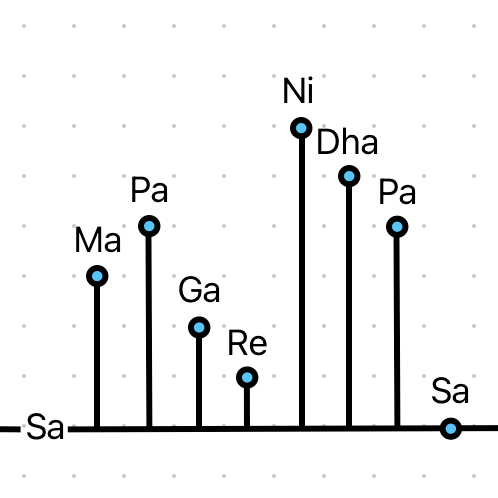
But we haven’t yet fully decoded its rhythm (the pattern in time). What we have so far is a sequence of claps with the same rhythm…
…and a somewhat clunky visual representation (Part 11):
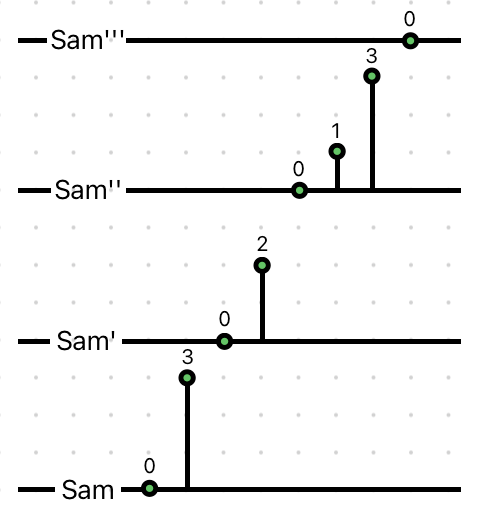
Make sure you’re able to connect the visuals to the audio. You’ll need that connection for what follows.
Also, feel free to brush up on our melodic rhythm journey so far:
Melody-Tempo Audio Cocktail
Our current visual representation uses explicit tempo-beat lines (Sam, Sam', Sam'',…) as references for the timing of each pitch1.
This is analogous to how tempo can be used as a reference when listening to a melody. In fact, let’s make the tempo-beats explicitly audible by layering them onto the audio version of The Melody.
Here are four tempo-beats:
And here’s what we get if we overlay these tempo-beats onto The Melody:
This process is the basis for understanding the rhythm of almost any melody.
Our current visual representation, though, doesn’t seem to capture the simplicity of this tempo-infused audio. Let’s partly remedy that through better naming.
Numbers Can Be Names Too
We can start off by changing how we name tempo-beats. Since there’s no limit to how many tempo-beats melodies might need2, it makes sense to use a system that remains simple even when there are many tempo-beats (for example, 20 tempo-beats).
The simplest such system we already know is the sequence of natural numbers. So, instead of piling up apostrophes (') like we are now doing, we can use the numbers 0, 1, 2, 3,… and so on for successive tempo-beats.
With this change, we lose some of the clutter:
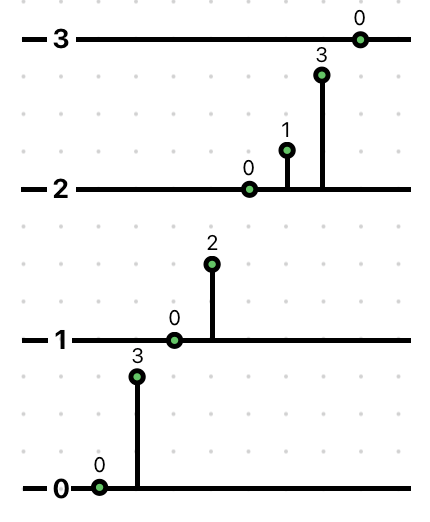
But this creates a new problem. Every name is now a number, so the same name can refer to more than one thing, like the two zeros at the bottom of the above picture, for example.
It’s not too hard to find a workaround though. For example, the timing of the third pitch can referred to as 1-0, since it’s located at beat 0 (from our beat dictionary) on the tempo-beat line 1.
Still, that can be a bit confusing. Let’s find a more elegant way by recalling our naming scheme for pitch.
Learning from Pitches
We never need more than 4 octaves to notate pitch for most melodies, so apostrophes (') and underscores (_) are more than enough for differentiating octave-shifted versions of any pitch, for example: Sa', _Sa and Sa; or Re', _Re and Re.
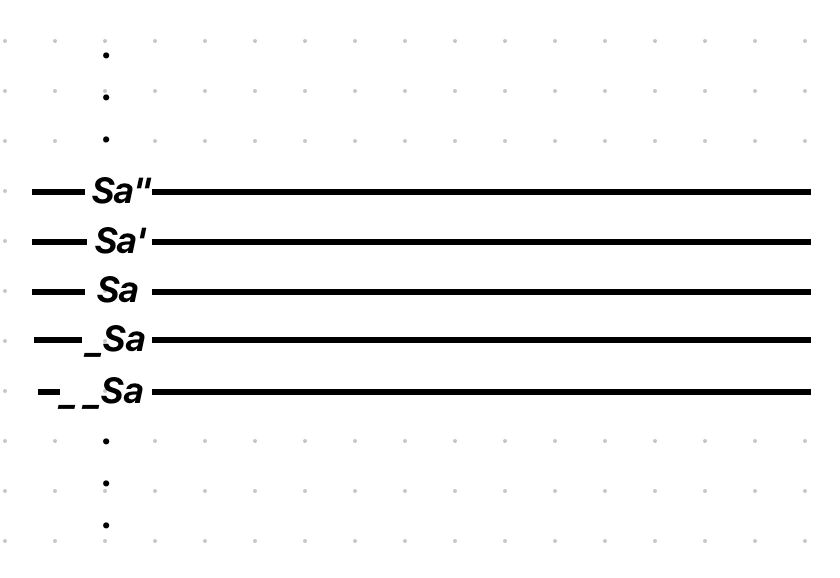
Coming to the base pitches themselves, we’ve been using just 7 of these, so it feels reasonable to have given them non-numerical names (Sa, Re,…, Ni).
Arguably, this makes the process of using pitches more connected to musical expression (like painting with colours) and less like counting with numbers.
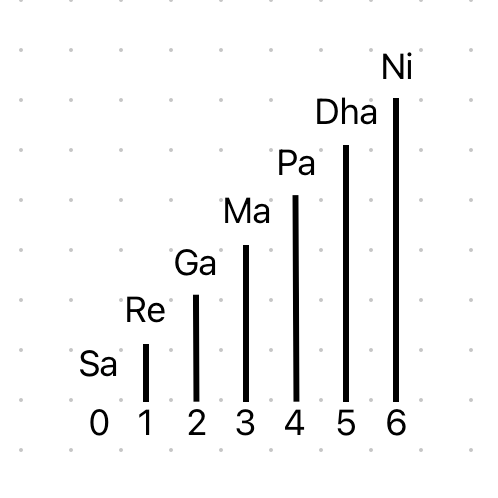
Can we apply similar ideas to beats?
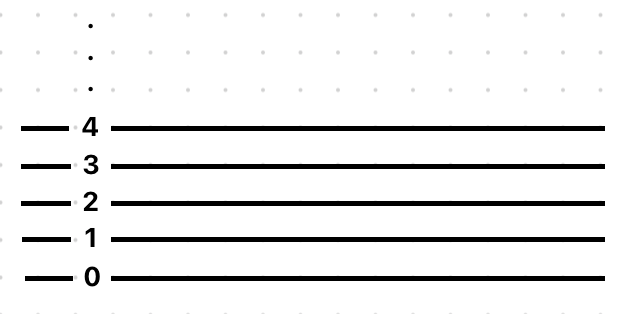
Tempo-beats, which are the rhythmic counterparts to Sa-octaves, can effectively increase without limit. Therefore, it makes more sense to number them 0, 1, 2, 3,… instead of adding apostrophes indefinitely.
What about the beats from our 4-beat dictionary? These are rhythmic analogues to the pitches from our 7-pitch dictionary.
These beats are limited in number and are used repeatedly just like our 7 pitches, so it makes a whole lot of sense to give them reusable names as well!
Beat Dictionary 2.0
The names we’ll be using for the beats from our 4-beat dictionary are: Ta, Ka, Di and Mi.3 With this new scheme, our 4-beat dictionary would now become:
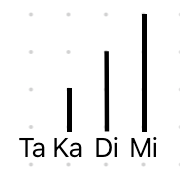
Here too, naming (instead of numbering) turns these beats into something akin to colours that we can use to paint our rhythms. We don’t need to count. Instead, we can just focus on the embodied experience of the rhythm.
Beat Levels
After all these naming changes, the rhythm of The Melody would look like this:
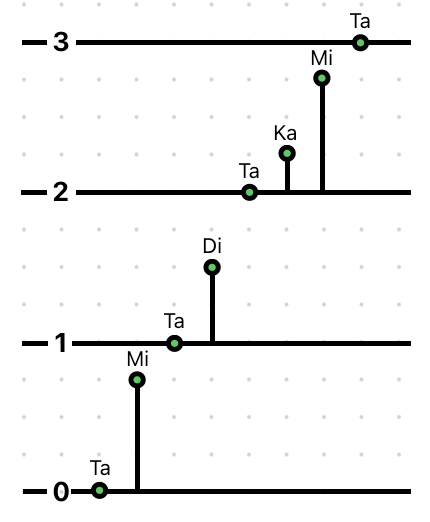
Essentially, we have two kinds of beats to help us decode The Melody:
Tempo-beats, which act as repeating references, and can be thought of as outer beats in the current context.
Beats from our 4-beat dictionary, which give us the timing of various pitches with reference to the most recent tempo-beat, and can be thought of as inner beats in this context.
In the case of The Melody as pictured above, we can say that:
the tempo-beat 0 (outer beat) supports Ta and Mi (inner beats),
the tempo-beat 1 (outer beat) supports Ta and Di (inner beats),
the tempo-beat 2 (outer beat) supports Ta, Ka and Mi (inner beats), and
the tempo-beat 3 (outer beat) supports Ta (inner beat).
In a separate series, we’ll see how this simple, 2-way difference can be expanded to include many more levels. For now though, the main takeaway is that each layer of beats supports all the beats that are “inner” to it.
Done! Somewhat.
At this point, it could be said that we’ve decoded the rhythm of The Melody. We can read off the beat-pattern from the visual representation above (TaMi TaDi TaKaMi Ta), and move on.
But — we have some loose ends to tie up.
There’s one oversimplification in our present framework that we need to be aware of before we can fully comprehend the rhythm of The Melody at a basic level.
Also, the representation we have is still visually cumbersome. We can simplify it to more accurately reflect how we (or at least, I) experience rhythm and time.
See you in the next part!
Do you love music? And learning? If you’d like to discover some of the more intimate intricacies of music and support me along the way, please consider subscribing. I’d love to learn from you as well!
Um, ackkshually… the timing of the start of each pitch.
Practically, yes, of course there is a limit. But even that could involve a significant number of tempo-beats — way more than 10.
These come from a vast system of South Indian percussion syllables, collectively called solkattu.