
Tempo's A Pitch
Melody: Part 18

How are tempo and pitch connected? Let’s find out by repeatedly doubling tempo and seeing where that leads us.
For a refresher on pitch, start here:
For a refresher on time, start here:
Recalling Old Friends
Remember the set of beats from Part 9 that we had called V? If you recall, we had used it as a reference to explore tempo. Let’s listen to V again:
This is fairly familiar territory for us. It’s just a sequence of equally spaced beats. That means the overall sequence has an unchanging tempo.
For comparison, let’s take the other beat-sequence W from Part 9, which has a higher tempo than V:
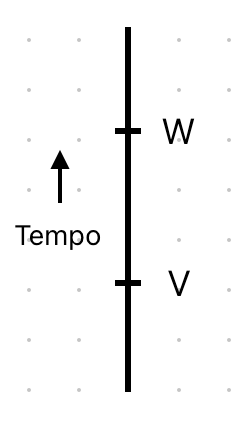
We had compared V and W by representing tempo on a vertical line, with a faster tempo (less time between beats) going higher up on the line and a slower tempo (more time between beats) going lower.
This is how V and W compared in our visual representation:
Double or Nothing
To understand how tempo connects to pitch, we’re going to keep doubling tempo, starting with our baseline, V’s tempo.
Visually, 3 consecutive doublings of V’s tempo would look something like this:
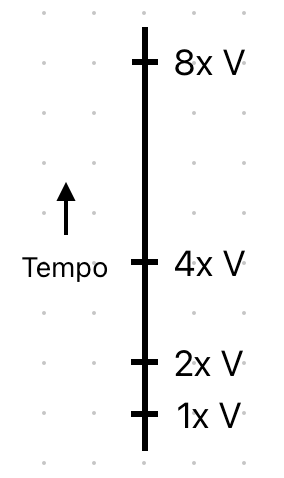
Basically, with every doubling of tempo, we get twice the number of beats in the same amount of time.
Let’s remind ourselves of V’s tempo1:
And here’s a sequence of beats with double the tempo of V (2x):
The doubled double, at 4 times the tempo of V (4x):
And twice of that, so 8 times the tempo of V (8x):
Repeating the process, 16 times V’s tempo (16x):
32 times V’s tempo (32x):
64 times V’s tempo (64x):
Hmmm. Is that a tempo? Or perhaps a pitch?
128x V’s tempo:
Ok, now that’s definitely a pitch!
The Pitch-Tempo Continuum
256x V’s tempo:
Somehow, we seem to have crossed over into the realm of pitch by only doubling tempo.
512x V’s tempo:
Now, this isn’t just any pitch. It’s _Sa (one octave below Sa)!
And doubling once again, at 1024x V’s tempo we have:
This is Sa, the pitch of our old friend T from Part 12.
We started with the tempo of V and ended up with the pitch of T. They’ve been connected this whole time!
Although we perceive pitch and tempo in very different ways, this deep connection convincingly places them along the same continuum.
Doublings Give Octaves
Since we got from _Sa to Sa in the above sequence by “doubling the tempo”, we’ve also discovered that one tempo doubling is equivalent to one octave ascent!!
Conversely, halving the tempo is equivalent to descending by one octave.
I don’t know about you, but to this day, I find this to be one of the most surprising relationships in music: we start out with a sequence of pitch-less beats at a particular tempo, but after repeated doubling of tempo (or we could say, repeated octave ascents), we obtain single pitches!
What’s Next?
While this only scratches the tip of the iceberg, going further in this direction would detract too much from the main aim of this series, which is about decoding melodies.
With that said, I hope this has shown how seemingly unrelated musical entities can have deep underlying connections. Finding such connections can help us discover rich musical ideas that are hidden in plain hearing.
We’ll get into pitch-tempo connections in greater detail in a separate series, but for now, let’s take a second to celebrate how far we’ve come. This part effectively concludes the purely rhythmic part of the Melody series!
It’s really commendable that you’ve made it this far, so a rhythmic pat on the back is in order: TaDiTaT!
I hope you’re ready for the next leg of our journey, where we’ll explore the third melodic element: LOUDNESS.
Do you love music? And learning? If you’d like to discover some of the more intimate intricacies of music and support me along the way, please consider subscribing. I’d love to learn from you as well!
The sound of each constituent beat of V has been simplified, but what is relevant is that the tempo is exactly the same as before.
This sounds buzzier when you compare it to the original T because of the choice of sound used for the beats of V. The important thing to note is that the pitch is the same as T’s pitch.