
A Stitch in Time
Gati: Part 1

Checkpoints in Time
Checkpoints in space tell us where we are, while checkpoints in time tell us when we are.
How would you understand the following rhythm:
The rhythmic idea of gati is going to be our friend here. But to see how, we’ll first need to travel through the byways of tempo.
As we’ve seen in the Decoding Melody series, tempo-beats are the trusty timing checkpoints we rely on, using which we understand the timing of other beats that make up a piece of music.
It’s important to ensure that tempo-beats are as regularly-spaced as possible, in order to have conveniently placed timing references recurring throughout a musical passage.
I’d highly recommend going through this post if you’d like to acquaint yourself with tempo:

Woven Through Time
Each beat (tempo-beat and otherwise) can be thought of as being stitched at a specific position in the fabric of musical time.
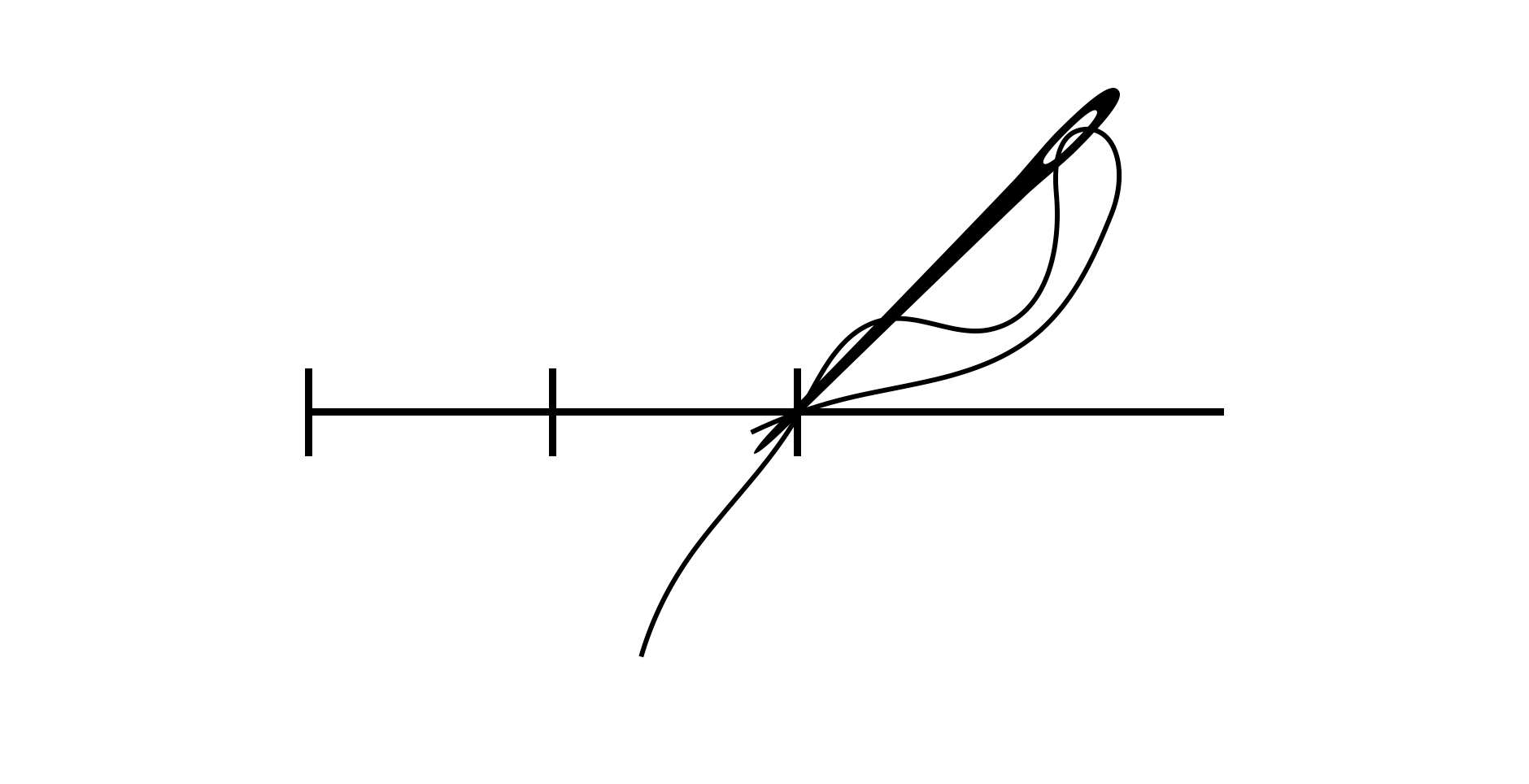
In this way, all beats (i.e. musical events) constituting a musical piece form a specific pattern in time.
So, for example, when the musical events in question happen to be pitched sounds, each pitch can be thought of as a bit of coloured thread, and various lengths of these coloured threads are used to form a pattern of colour on the fabric of time.
Each event, then, has a starting position (onset beat) as well as a length (duration) in the context of a musical piece’s fabric.
Ground Zero
Let’s begin our foray into gati by listening to the simplest recurring rhythmic pattern — beats separated by the same duration:
And this is how we can visualise this pattern:

Music Nerd Note: Without loss of generality, we’re assuming that each beat signifies the onset of a musical event with the same duration.
Varying Tempo
How would it sound if the duration between beats changed?
Let’s listen to 3 patterns:
The same one from above,
one where the duration between beats is slightly reduced,
and one where the inter-beat duration is slightly increased.
You can hear them in the above order, each using a different sound so it’s easier to distinguish them from each other:
And here’s the visual:

Reference Tempo
How would the 2 new patterns above sound, when overlaid over our initial pattern?
Here, you can hear the 3 patterns from above, all overlaid on the first pattern in such a way that the first beats of overlaid patterns line up:
And here’s how we can visualise this:

One way to model what’s happening above is to think of the first pattern as the reference tempo and the other 2 patterns as scaled (up and down) versions of the reference.
Tempo Octaves
We’ve seen earlier how doubling tempo is analogous to going up an octave in pitch, and how halving tempo parallels going down an octave.
Let’s now listen to 3 tempi in order:
our current reference tempo from above
the overlay of half our current reference tempo onto the reference,
and finally an overlay of double the reference tempo onto the reference:
Here they are in the above order:
And here’s the visualisation:

Managing Chaos
We’ve now heard overlays onto the reference tempo with 2 different kinds of tempo changes:
Slight tempo changes: Changing to an “uneven” tempo, and
Changing tempo by powers of 2: Changing “evenly” to half or double of the reference.
Here’s an important question: Do you feel that the half/double overlays onto the reference tempo sound less chaotic than the earlier non-even overlays?
If yes, why do you think it feels that way?
Observing how we feel about this will bring us closer to an intuitive idea of gati, so it might be worthwhile thinking through this in a deeper way.
What’s Next?
We’ll see how gati naturally arises as a practical way to understand timing relationships in rhythms.
Do you love music? And learning? Well, then Sound Insight is the place for you!
If you’d like to spread what you’ve learnt (and support me along the way ;D), please consider sharing this post.
If you’d like to learn more, please reach out through comments/DMs. I’d love to learn from you as well :)