
Time is Relative
Melody: Part 10

Now that we’ve had an overview of tempo in the previous part of the Melody series, we can take a closer look at the elements of time. If you need a refresher on tempo, here you go:

Order
It goes without saying that we perceive sounds in the order that they occur. When we hear two non-overlapping, sequential pitches, one is heard earlier while the other is necessarily heard later.
An obvious consequence of this is that in a melody, depending on how many pitches it has — there’s a first pitch, a second pitch,…and so on until we get to the last pitch.
A familiar example is the central melody of this series: The Melody. Here’s how it sounds:
And this is its visual representation:
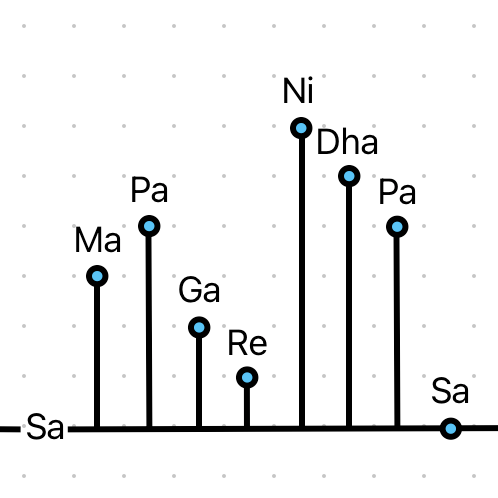
Clearly, Ma is the first pitch and Sa is the last.
Even or Odd?
The time-order of pitches is pretty apparent, but how do we relate the exact timing of these pitches?
In other words, how do we figure out its rhythm?
Let’s revisit the question we posed in Part 9. If we clapped with the start of every pitch of The Melody, this is what the sequence of claps would sound like:
This is, in essence, the rhythm of The Melody. The question at the end of the last part was: are all the claps evenly spaced?
If they are evenly spaced, then this is basically a tempo-like rhythm, and we don’t need to figure out anything more.
But — here we are with another part in this series, so if listening to the rhythm didn’t give you an answer, I’m sure you’ve guessed by now that the answer is: no, the claps are not evenly spaced.
The good news is that we can still use the idea of tempo, coupled with a new idea — duration — to make sense of the rhythm.
Duration
Simply put, duration is the time between two instants. For example, how long would it take for me to go from my current bald self to having (without treatment) a head full of hair? It’s simple: forever.
Duration shares parallels with something that we’ve explored in Part 2: pitch interval.
Just like intervals help us express relationships between two pitches, durations help us express relationships between two instants of time (or two beats).
Thanks to their structural similarities, intervals and durations can be visually represented in much the same way.
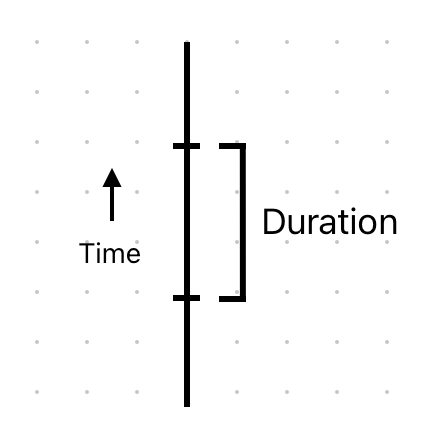
We can represent a duration by a line joining two points in time:
Referential Relative Time
In yet another parallel with pitch, this time self-imposed, we can choose one specific instant of time to be our reference for all future instants.
We can then relate all other points in time to this reference. This is similar to how we relate the current daily time to a reference, 12 midnight (0000 hrs).
Let’s see how relative time translates visually.
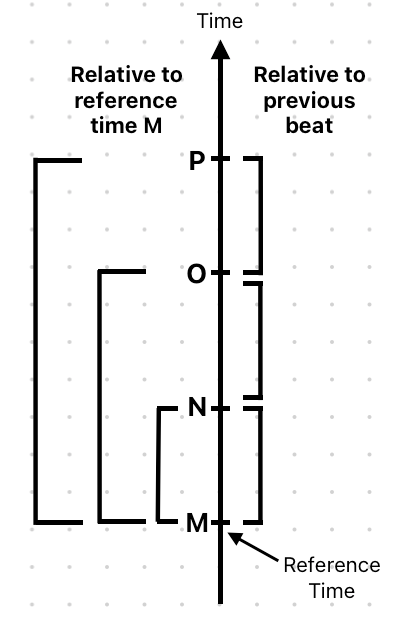
Let’s say we have 4 beats: M, N, O and P.
These 4 beats can be related either to the first beat M (durations to the left of the vertical timeline in the picture below) or to the immediately preceding beat (durations to the right of the timeline):
In the domain of pitch, we had chosen Sa to be the reference pitch. In the realm of time, the simplest choice for a reference would be the instant at the very beginning of a melody. We’ll call this the Sam (pronounced s-uh-m, as in the “sum” of two numbers).
Duration Dictionary
By this point, it shouldn’t be a surprise to find another parallel with pitch.
Just as we had a dictionary of intervals represented by lines, we can have a dictionary of duration-lines. Here are four durations represented as lines:
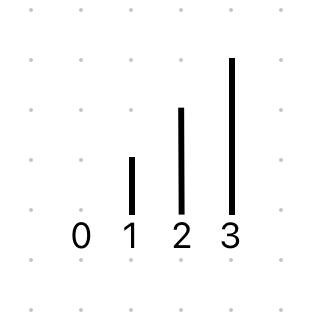
We’ll use each of these lines to represent a unique duration from the reference Sam. Of course, one of the “lines” has zero length — that’s because it’s the Sam itself.
Including the Sam in this way is very useful for decoding rhythm patterns, just like including the zero-length Sa was useful when figuring out pitch patterns.
A Test
Here’s an exercise that’s similar to what we had done using our 7-line pitch dictionary in Part 3.
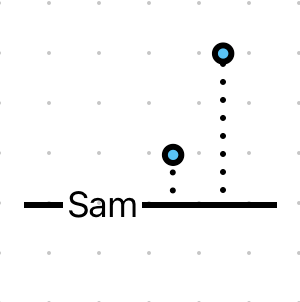
The horizontal line is Sam. The points are instants of time, arranged in order from left to right.
Match 2 of the lines from the 4-duration dictionary to the corresponding blanks, by comparing line length. This is what you should get:
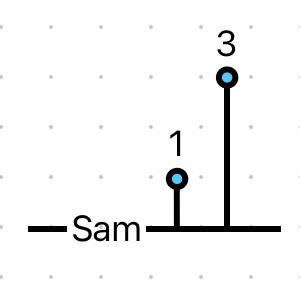
If you solved that in less than an hour, let us know in the comments!
Beat or Duration?
Now, do we care about the lines or just the points at the top of these lines?
Phrased differently, are we focusing on the beats or the durations?
Well, both… But we’re focusing a bit more on the beats.
When decoding pitches, we used intervals to relate pitches to the reference Sa. Those pitches were the points at the top of the interval lines. So while we mainly focused on the pitches, we did this by using Sa-relative intervals as our tools.
In the time domain, we’re using duration-lines to relate instants of time (or beats) to the reference Sam. These beats are the points at the very top of each of these lines.
So, in short, we’re focusing on the beats in relation to Sam by using Sam-relative durations as our tools.
What’s Next?
Although this particular visual representation for time is similar to the one we used for pitch, we’ll need to make significant changes to it before it can be used to transparently represent rhythms. In fact, using just the 4-duration dictionary and a single Sam, we can’t yet represent The Melody’s rhythm.
In the next part, we’ll explore the the directionality of time, which will eventually help us update our visual representation.
Next → Part 11: Recycling Time
Thanks for reading!
Do you love music? And learning? If you’d like to discover some of the more intimate intricacies of music and support me along the way, please consider subscribing. I’d love to learn from you as well!