
Beat Symmetry
Melody: Part 15

In order to handle more complicated rhythms, let’s see how tempo-beats play a strikingly similar role in time as Sa-octaves do in pitch.
Rhythmic Cylinders
Taking a cue from Part 5, where we represented the pitches of The Melody as cylinders, let’s turn The Melody’s rhythm into a series of cylinders.
We’ll use a slightly cruder version of our rhythm representation so that we can easily observe it from different vantage points. Here’s how we’ll represent The Melody’s rhythm:
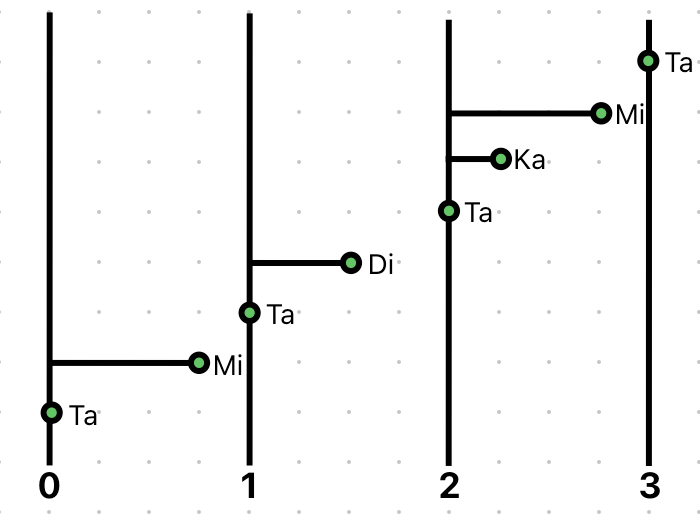
After we remove the points at the ends of the lines, and turn the lines themselves into cylinders, we have:
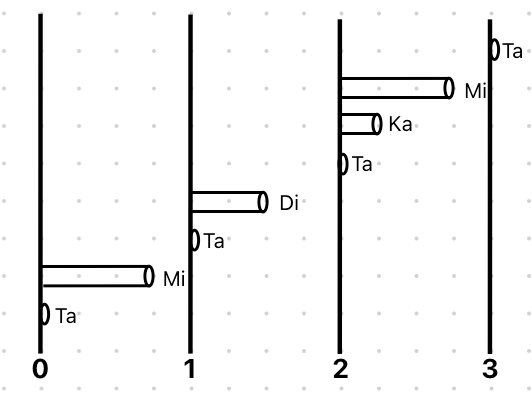
Looking at these cylinders from the front, we see only horizontal bars:
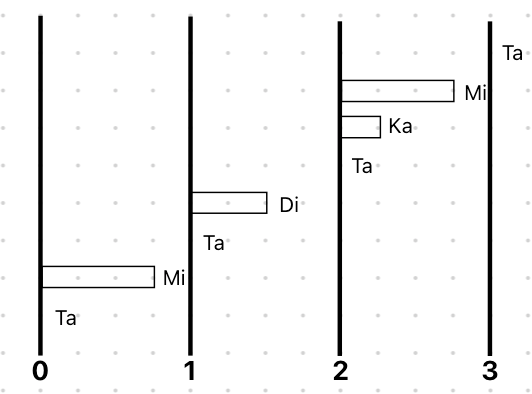
This is just the Front View. What if we view this from the right side?
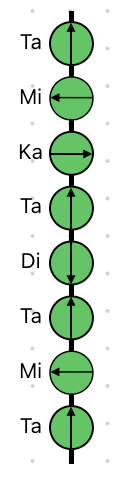
Starting with the first (lowest) beat Ta, we now see only the circular tops of the cylinders. Also, just like with pitch cylinders, these circles have arrows on them.
What do they represent?
Beat Spiral
Let’s try to think of time in terms of rotation.
Like the pitch spiral, we can have a beat spiral. Moving forward in time would be like moving along the coils of a spring.
To move further in time, you would move clockwise along the spiral, thereby also moving to the right.
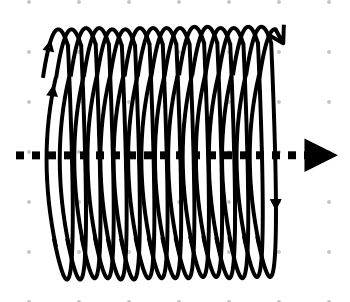
We’re doing this to divide time into equal pieces, where each piece is a repeating block. One loop of the spiral represents such a piece.
We already do this on a daily basis when we divide a day into 24 piece, each an hour long.
While we don’t think of 12 pm yesterday as being the same instant of time as 12 pm today, we still use the same hourly labels for timekeeping. These repeating names, in conjunction with larger (slower) units — like date and month — and smaller (faster) units — like minute and second — help us keep track of time.
This is the essence of our 4-beat dictionary. It uses just 4 inner beat names, coupled with tempo-beat numbers, to keep track of rhythmic time.
Let’s see how the beat spiral is embedded in the 4-beat dictionary.
The Right Side
Here’s the Front View of the 4-beat dictionary:
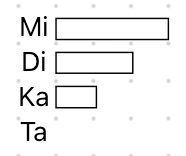
Looking at it from the right side, we have our Side View:
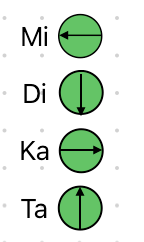
This makes it easier to see how the direction of each arrow is related to the timing of the respective beat.
Spiralling Forward
Distance in the front view has been replaced by angle in the side view.
Let’s traverse the beat spiral, step by step. Imagine you’re looking at it from the right (from the future):
We begin at the far end of the beat spiral, at the tempo-beat 0, where we also have Ta. The arrow is pointing at our current position — upwards (at 12 o' clock).
As we move clockwise on this spiral along its length, we are also inching towards the future. After a quarter turn, we’re slightly further in time and the arrow is rotated away from Ta. This is Ka.
At the halfway mark, we have Di.
Another quarter turn and we’re at Mi.
Moving further, we reach a point that is right above our first Ta. This is also Ta, but we’re now at tempo-beat 1.
Rotationally speaking, we’re back where we started. But overall, we’ve gone a bit further into the future.
Every complete round takes us to the next tempo-beat. This is (by definition) what makes it such a great reference. Most importantly, this aligns very well with how we experience tempo and rhythm.
The Tempo Apartment
For a moment, let’s go back to thinking of time on a vertical axis.
Tempo-beats are then like the floors (levels) that we climb as we go through the apartment of melody.
We start at the base of the apartment (tempo-beat 0).
The staircase that we take to climb up to higher floors has 4 steps between every pair of floors. These are the inner beats Ta, Ka, Di and Mi.
The arrows in the Side View tell us which step we’re on. The most recent tempo-beat tells us which floor we’ve just been on. After one cycle of Ta, Ka, Di and Mi, we reach the first floor: tempo-beat 1.
Another cycle of inner beats gets us to the second floor, tempo-beat 2, and on we go until we reach the last beat on the top floor of our melody-apartment.
What’s Next?
If all of this rings a bell, try to spot the similarities between what we’re doing now and our exploration of pitch from earlier in this series. How many similarities can you spot?
In the next part, we’ll explore the rhythmic contour of The Melody using what we’ve developed so far. This will reveal the symmetry that tempo-beats generate, which is why we’ve chosen them to act as time references.
Thanks for reading!
Do you love music? And learning? If you’d like to discover some of the more intimate intricacies of music and support me along the way, please consider subscribing. I’d love to learn from you as well!
I love this! Fascinating read!