
Time Turner
Melody: Part 13

Here’s our well-worn friend, The Melody:
And here’s how far we’ve come in our quest to decode its rhythm (Part 12):
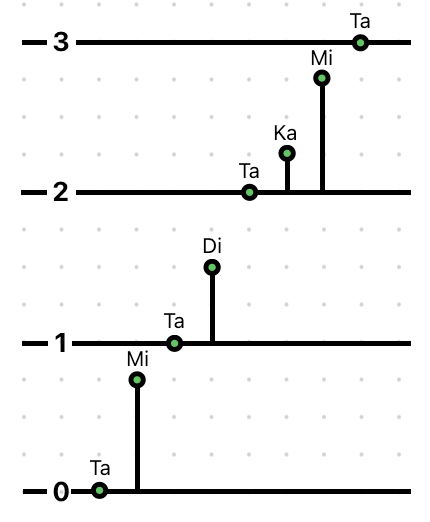
With a little effort, we can radically simplify this picture. Let’s begin!
The Tower of Beats
Here’s a simple 3-beat rhythm, shown here with our updated naming scheme from Part 12:
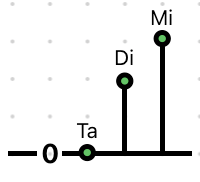
From Part 11, we know that durations from the same reference Sam only increase with time. In fact, in the above 3-beat rhythm, this manifests in two ways:
later beats (longer durations) are higher up than earlier ones (shorter durations), and
later beats are to the right of earlier ones.
This is superfluous redundancy, just like the phrase “superfluous redundancy”.
Let’s simplify. Instead of having future beats both higher and to the right of past beats, let’s stack them up along the same vertical:
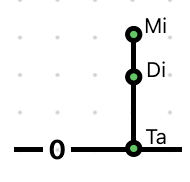
To go through the rhythm from beginning to end, we start with the lowest beat and progress upwards. The order of beats is still perfectly clear: high equals late — just like people.
The Stacked Melody
We can apply beat stacking to longer melodies as well. Stacking only the inner beats of The Melody, we get:
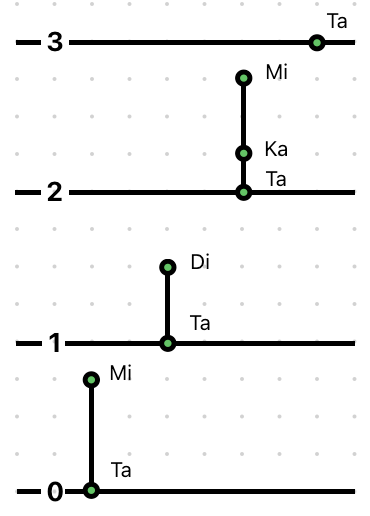
Going a step further, we get one giant stack:
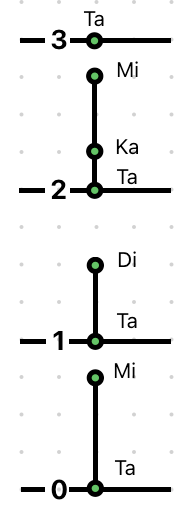
All of The Melody’s rhythm has now been condensed along a single vertical line!
Just Like Listening
This is not only simpler, but also shows durations between adjacent inner beats, while still showing durations relative to tempo-beats.
This is analogous to how many musicians (including me) perceive rhythms, as interwoven strands of tempo-beat and adjacent beat sequences.
This representation also mirrors the audio that we heard in Part 12: a combination of The Melody and tempo-beats.
Let’s revisit this audio. Here are just the tempo-beats:
And here is The Melody mixed in with these 4 tempo-beats:
This last audio is the one shown as a vertical stack above. Do you perceive how they’re both essentially two sides of the same coin?
Time to Lie Down
One thing about our current representation that’s bothering me is that it’s vertical.
This is problematic because, at present, we’re representing both pitch and time on a vertical line. This prevents us from combining them into one integrated representation without getting terribly confused.
Fortunately, the solution is simple: we’ll turn time onto its side.
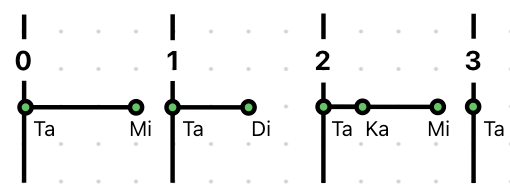
Now the first tempo-beat 0 will be all the way to the left and time will advance as we move to the right. As a bonus, this also happens to be in the same horizontal orientation as all this text you’re reading.
With this Cartesian change, we’ve made sure that the representations for pitch and time don’t interfere with each other.
Removing the (tempo-beat relative) duration-lines from the above picture, and tidying up some more, we get:
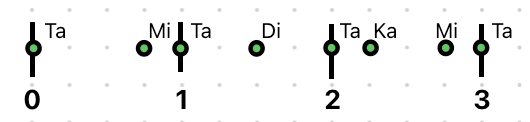
Pitches Have Tails
In order to fully represent the rhythm of The Melody, we need to include one more thing: pitch duration.
Up until now, talking purely in terms of beats has been more than sufficient, since we’ve only ever needed to mark instants of time.
Each instant that we’ve been marking has been the beginning of an event. Specifically, each such instant has marked the start of a pitch.
The start is only half the story though. We haven’t been marking the tail-ends of pitches. Every pitch has a duration, after all.
The duration of a pitch can be easily represented by a line starting from the initial beat where the pitch begins and then extending it to the right.
Here’s how The Melody would look with pitch durations:

How is this different from our earlier representation?
Earlier, duration-lines began with tempo-beats and ended with inner beats. These were our Sam-relative durations.
In contrast, duration-lines now begin at inner beats and go towards the right based on the duration of the respective pitch. These lines represent our pitch durations.
Calling Tails
But wait — in the picture above, why have we included the extra tempo-beat 4 at the end, with a line connecting the last inner beat (Ta) to it? Before this, we had only needed tempo-beats 0, 1, 2 and 3.
We’ve done this to show the duration of the very last pitch of The Melody. Listen once more and notice how the last pitch doesn’t end immediately, but lasts for a while:
The last pitch’s duration is being represented by the line connecting the last Ta (on tempo-beat 3) to the tempo-beat 4 in the picture above.
Let’s make the last pitch’s duration verbally explicit. For this, we’ll need to change the name of our last inner beat in the following way (prepare for a wall of words):
We set aside the name of the beat where the final pitch starts (pitch-starting beat) → Ta (on tempo-beat 3).
Next, we take the name of the beat where the last pitch ends (pitch-ending beat) → Ta (on tempo-beat 4),
And we remove the vowel at the end of this pitch-ending beat’s name to get a consonant → T , and
Finally, we add this consonant T to the end of our pitch-starting beat’s name — Ta — to get a compound sound → TaT.
If that wall of text proved too slippery to scale, look at the picture below and then go through the above steps again. It should be clearer the second time around.
A Portrait of The Melody
With this, our picture of The Melody’s rhythm turns into:
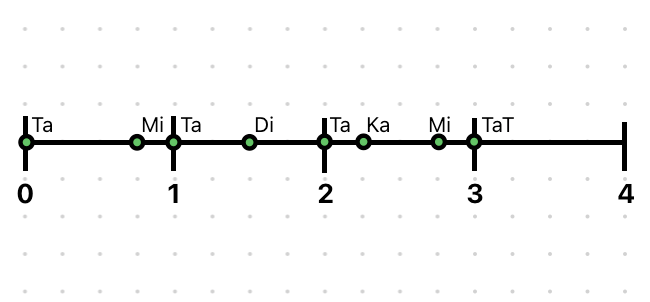
Leaving Silences Unsaid
You may have already noticed that each pitch in The Melody ends where the next one begins. That’s why every duration-line goes all the way to the beat where the next pitch starts.
Ideally, for any given melody, we’d need to mark the ends of pitches as well, since there could be a period of silence between two pitches.
Fortunately, we can safely sidestep this (valid) concern for now by assuming that the end of every pitch is the start of another. If there are any silences, we ignore them.
At Long Last
We made it! With these small but crucial additions to our understanding, let’s take the final step and remove all lines and points from our visual representation.
We’re left with the rhythm, decoded:
TaMi TaDi TaKaMi TaT
What’s Next
We’ll take our understanding of rhythm and put it to use with some rhythm recognition challenges. Of course, these will be all-audio challenges.
Do you love music? And learning? If you’d like to discover some of the more intimate intricacies of music and support me along the way, please consider subscribing. I’d love to learn from you as well!