
Stirred Together
Melody: Part 23

The Story Thus Far
After only 22 (!) parts of the Decoding Melody series, we’re at a point where we can combine the elements we’ve discussed so far — pitch, time and loudness — into one unified representation.
Here’s the one thread that has looped through this entire series, The Melody:
Let’s begin by uniting The Melody’s pitch and time representations.
The Right Time
Before Part 13, we had been representing time on a vertical line.
That changed once we noticed that both time and pitch were represented vertically. To remedy this, we turned time on its side and placed it along a horizontal line.
But why did we bother doing this?
It wasn’t for aesthetic pleasure, but for the very practical reason of being able to combine pitch and time into one integrated representation.
If we had continued with both pitch and time on the vertical, we would have been hard pressed to tell which point was a pitch and which was a beat.
Naturally, in order to avoid such confusion, and with some commendable foresight, we turned time onto its side.
Orthogonal
Here’s the visual representation of The Melody’s pitches as we last left it:
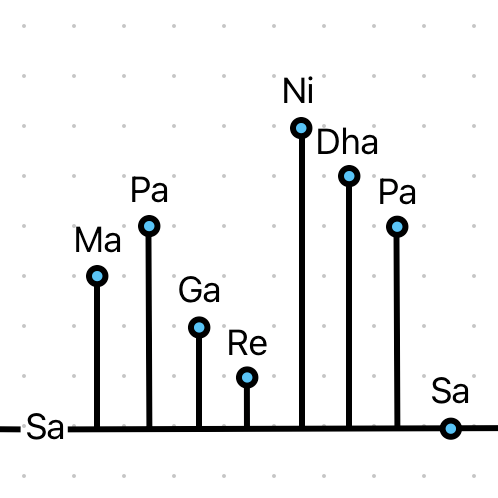
Notice that the pitches, while varying vertically in the pitch representation, are equally spaced in the horizontal direction. The actual timing pattern of each pitch is absent from this picture.
And here’s the visual representation we had come up with for The Melody’s rhythm:
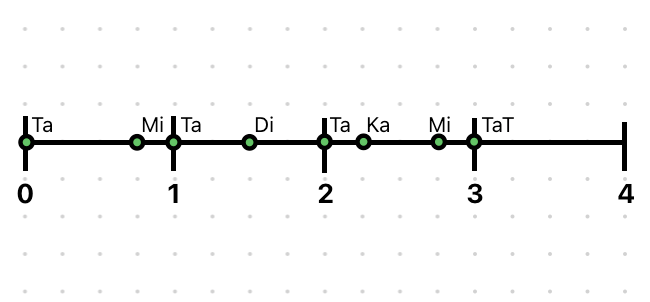
Notice that all the beats shown here are on a single horizontal line. Let’s also recall that every beat of the rhythm (represented by a point) signifies the start of a pitch.
In addition, for every beat, the pitch duration line begins at the beat and goes to the right to signify the duration of the respective pitch.
Spaced-Out Pitch
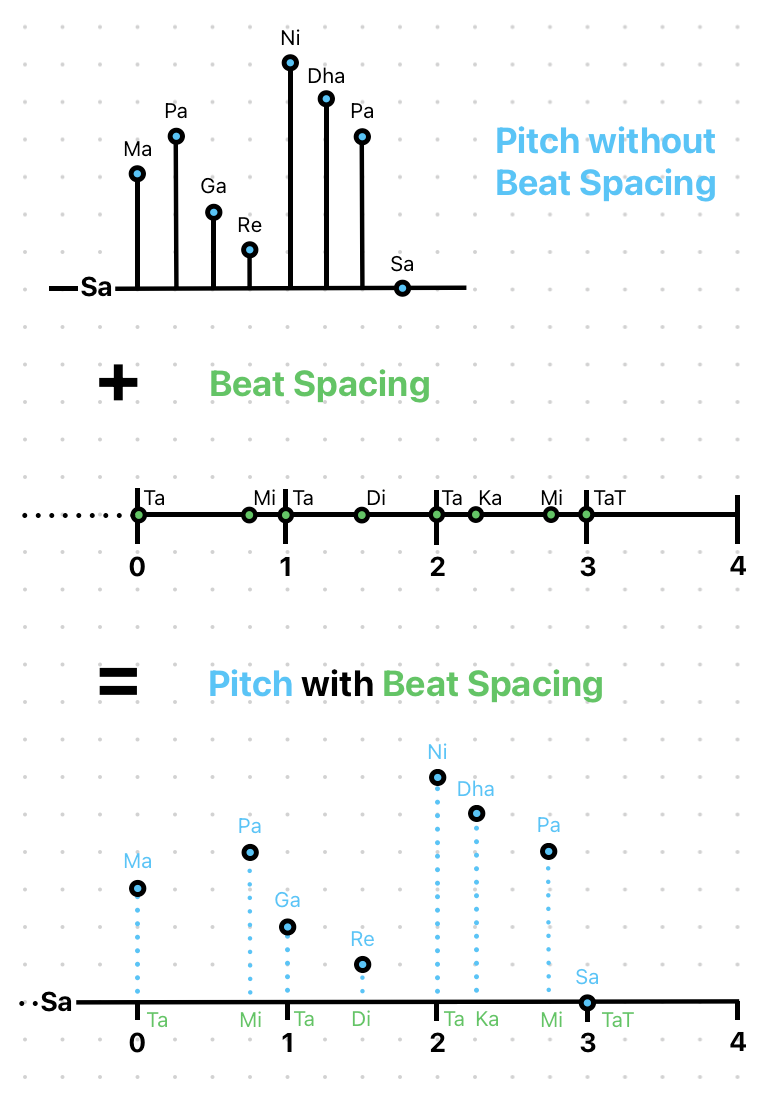
To have both pitch and time in one visual representation, we first need to incorporate the beat spacing from the time representation, into the pitch representation:
Enter Pitch Duration
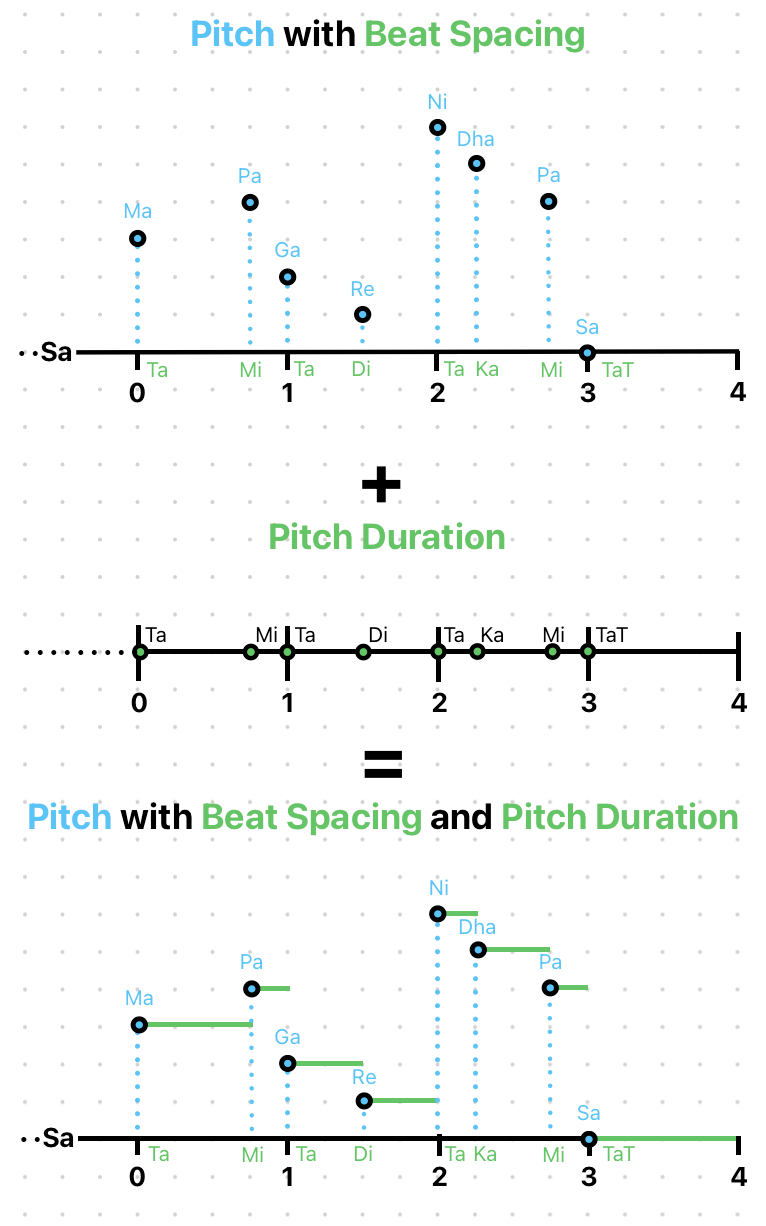
To our spaced pitches, we add pitch duration lines at the corresponding pitch heights:
Pitch-Time Scaffolding
We can reduce some of the clutter in our current picture by noticing that all the names that we’re using are dependent solely on position.
Let’s draw a vertical line to the left with all pitch names on it, and also mark the horizontal line at the bottom with all beat names.
For a bit of visual assistance, let’s also temporarily add in some dotted lines:
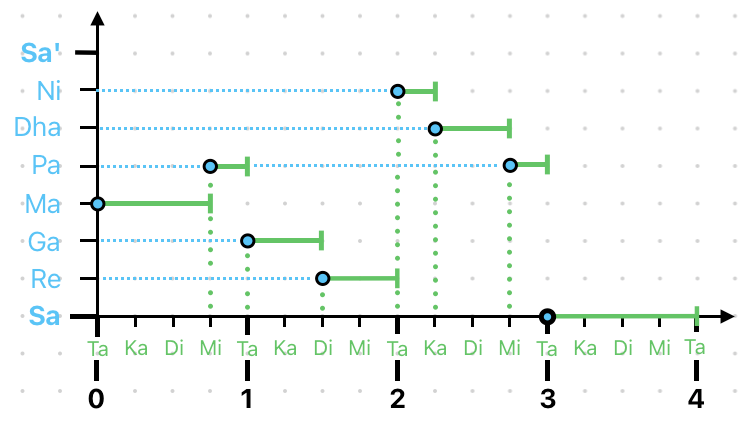
The Melody in Pitch-Time
Time to take down the scaffolding and unveil our creation!
Once we remove all the dotted lines, we’re left with a picture of The Melody that mirrors our perception of listening to it (in terms of pitch and time):
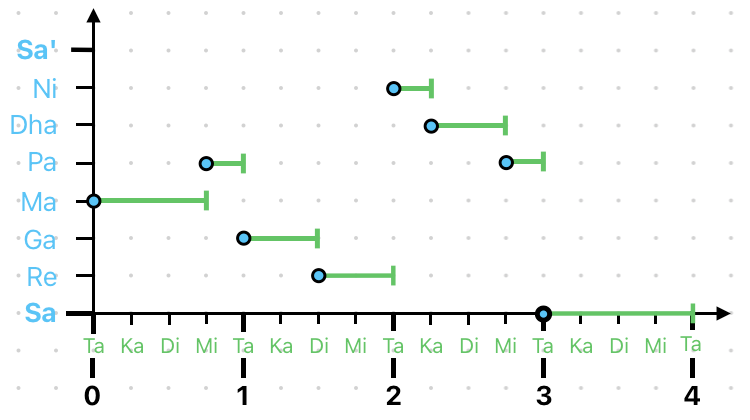
This is the combined pitch-time representation of The Melody!
Textural
Short of using a 3-dimensional representation, how do we add loudness to our combined pitch-time representation?
First, let’s turn our pitch-time lines into pitch-time bars:

Next, we can mark our pitch-time bars with textures matching different loudness levels, thereby fitting more information into an already packed space.
This is how we’ll mark loudness:
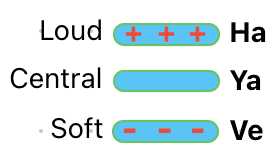
The Melody’s Final Form
Here’s the visual representation of The Melody’s loudness contour we had developed earlier:
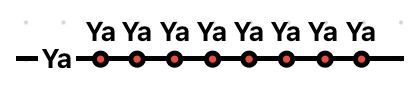
Converting these into textures according to our framework above (trivial — I know!), and combining these with our pitch-time representation, we get:
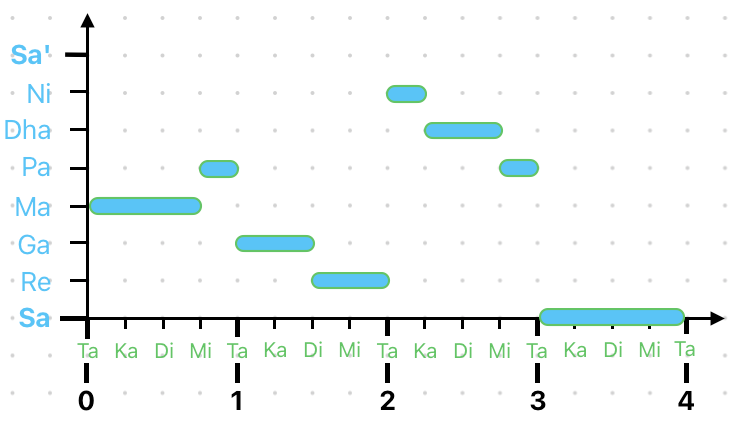
And that’s it! This is the pitch-time-loudness representation of The Melody!
Listen to The Melody once again and see if you can follow along with the picture above.
I hope you were able to follow along.
And that’s it for The Melody! Congratulations on making it through!!
Are We There Yet?
We’ve come a long way, and in a sense, the journey is never-ending. Nevertheless, we’ve definitely reached a major milestone.
We had set out to decode The Melody, and now, we’ve achieved that end.
A great way to internalise what we’ve learnt so far is by actually decoding melodies.
This is exactly what we’ll attempt in the remainder of the Melody series. We will take these 23 parts of our melodic journey and put them to use by decoding some existing (and hopefully familiar) melodies.
See you there!
Do you love music? And learning? If you’d like to discover some of the more intimate intricacies of music and support me along the way, please consider subscribing. I’d love to learn from you as well!