
Aloud and Kicking
Melody: Part 19

We’ve answered the call of pitch, loud and clear (A Melodic Pitch Primer).
We’ve pitched ourselves on the fabric of time (A Melodic Time Primer).
It’s now time to take on loudness.
Calibrate Your Device’s Volume
Before we begin, let’s calibrate our device volumes. Listen to the following sound:
Set your device volume to a level where you can clearly hear this sound without it being painful or uncomfortable.
Listen to all the audio examples that follow at this same device volume that you have set based on the above audio.
The Experience of Loudness
Here’s a sound:
Let’s call this X.
Here’s another sound:
Let’s call it Y.
What makes these sounds different from each other? Loudness.
This is how X followed by Y would sound:
Do you notice the moment in the middle when the loudness changes?
This is the sound of Y followed by X:
What about Y followed by Y? It’s just two sounds with the same loudness:
Ranking Loudness
If we have to compare the loudness levels of X and Y, we’d represent it like this:
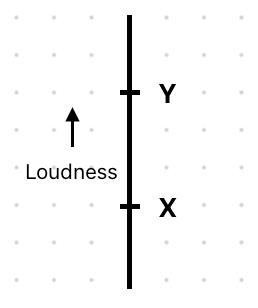
Y is higher up than X in this picture. We say that Y has a higher loudness compared to X.
Or more simply, Y is louder than X. Conversely, X is softer than Y.
Relative Loudness
Let’s briefly turn our attention from loudness levels themselves to the difference between loudness levels.
The difference between two pitches is an interval. The difference between the timing of two beats is a duration.
We’ll call the difference between two levels of loudness a range. For example, here’s the range between X and Y:
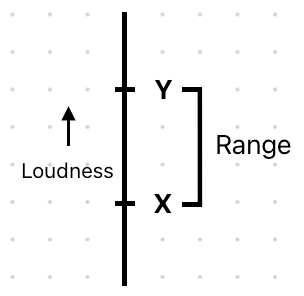
Referential Relative Loudness
Instead of arbitrary loudness comparisons, we’ll choose a certain level of loudness to be our loudness reference. We’ll then label the loudness of all sounds based on how they compare to this reference.
Let’s break it down. Let’s say we have 4 loudness levels: L, K, J and H.
We can either relate each of these levels to an immediately preceding level, or we could pick a reference loudness level (L, in our example) and relate everything to this reference:
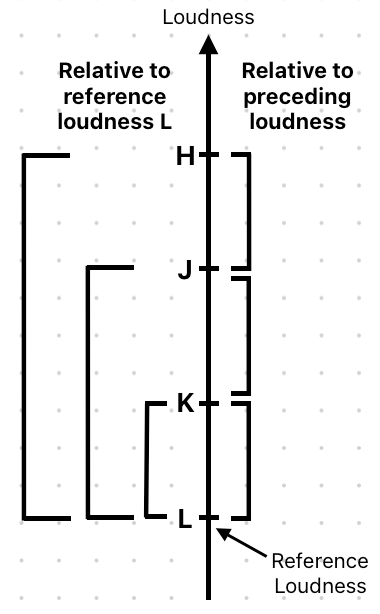
We’ll be using the second way, with a reference loudness level.
Silence
Our reference pitch was Sa and our reference beat was Sam. We’ll pick silence as our loudness reference, which we can label Si.
In the context of a melody’s pitches, Si is when you hear nothing:
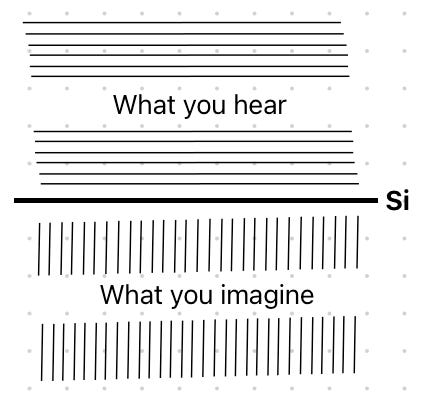
Here’s a melody with a period of silence in the middle:
Range Dictionary
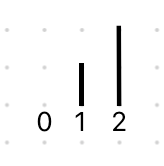
We’ve used an interval dictionary (Part 3). We’ve even used a duration dictionary (Part 10). It’s only fair that we now use a range dictionary.
Predictably, we’ll use vertical lines to represent ranges. Here’s the range dictionary visualised:
A Loudness Decoding Challenge
Here’s a sequence of beats:
Here is its loudness contour visualised relative to silence Si:
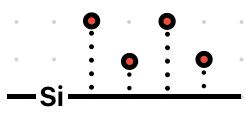
Try decoding the loudness sequence using the range dictionary above.
This is what you should get:
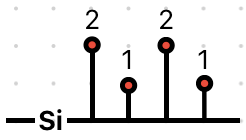
We are using loudness ranges from our range dictionary to decode loudness levels.
But really, our range dictionary can easily be thought of as a loudness dictionary, since these ranges are all relative to a reference (Si).
What’s Next?
Does loudness have its own version of a symmetry-generating entity, like Sa-octaves in pitch and tempo-beats in time? We’ll find out in the next part. Stay tuned!
Do you love music? And learning? If you’d like to discover some of the more intimate intricacies of music and support me along the way, please consider subscribing. I’d love to learn from you as well!