
Acclimatisation
Melody: Part 25

The Problem
Here’s a condensed variation of a popular childhood melody, which we will attempt to decode in this part of the Melody series:
Recognise it?
The Plan
To give you a tangible sense of what we’re about to attempt with the 5 melodies, we’ll use a 4-step process to decode our example melody:
First, we’ll decode only the loudness layer.
Next, we’ll decode the time layer.
Then, we’ll decode the pitch layer.
Finally, we’ll combine the 3 layers into one unified visual representation.
The Tools
We will be using specific tools to make the process of decoding by ear easier:
We’ll “extract” 3 layers of audio from the above melody — corresponding to loudness, time and pitch — with an audible reference mixed into each, if needed.
The 3 audio layers, with their references, are:
loudness (with no specific reference mixed in),
time (with inner beats and tempo-beats mixed in)
pitch (with Sa mixed in)
We will also have an audio dictionary for each layer, containing all named elements used in that layer.
You can listen to each of these in the individual layer sections below.
Since our entire system of naming (in all 3 layers) in based on comparison with reference elements, having access to audible references and audio dictionaries will reduce the need for memorisation.
So, instead of losing ourselves in the dense web of the melody’s original audio, we can clearly focus on one referenced layer at a time.
This brings each audio layer closer to its visual equivalent, in which a clearly visible reference is used as a point of comparison to label individual elements.
The Purpose of the Climb
Since decoding a melody by ear might feel intimidating when we’re starting out, it’s important to remember the simple purpose of this entire exercise: to make naming decisions.
We’re simply giving names to how we currently perceive the sounds that we hear.
In a way, that is the purpose of this entire series: connecting our perception to properties of sound, through specific names, to the best of our current abilities, and then checking our understanding.
It’s important to do the best with what we possess right now, and follow it up with a reality check. This is the way to learning and growth.
A Final Note on Names
In this series, names serve multiple functions. They help us:
differentiate between different sounds,
remember specific qualities of sounds,
express our understanding of sound, and
check our understanding of sound.
So if we’re ever unsure of some aspect of a melody (let’s say a particular pitch), the way forward right now is to commit to a decision: assign a name to the element in question based on our current best guess.
Success, right now, is simply deciding on a name that aligns with our perception, regardless of whether we’re “right” or “wrong”.
Committing to a name helps us be aware of our otherwise fickle perceptions.
With time and practice, we will develop precision and consistency in our perceptions, but that requires making a decision now and then checking our guess against what we consider to be accurate.
This is why the solutions to all 5 melodies will be provided, so that we have a chance to figure out the gaps in our understanding.
Let’s dive in!
Twinkle, Twinkle, Little Louder
Our first order of business is loudness.
We’ll extract our loudness layer by:
replacing all pitches of the melody with Sa, and
retaining the same loudness contour as the original melody.
Our loudness dictionary will comprise 3 ranges (Ve, Ya and Ha), ordered by increasing loudness:
With this conversion, the loudness layer will sound like this:
Try labelling the loudness of all 28 pitches that you hear in the loudness layer by using the loudness dictionary as a guide.
10 of these have have already been filled in to get you started:
Ya Ya _ Ya Ve _ _, Ya _ _ _ _ _ Ve, Ve _ _ Ve _ _ _, _ Ya _ _ _ Ya _.
Twinkle, Twinkle, Little Beat
Next, we’ll figure out the rhythm.
We extract the time layer by:
converting every pitch of the melody to Sa,
converting each Sa to one of 4 unique sounds (timbres) based on its starting position (Ta, Ka, Di or Mi) with reference to the tempo-beat.
Here’s our beat dictionary, comprising the tempo-beat (Ta) and the other inner beats (Ka, Di and Mi), each with a distinct sound:
With each pitch rhythmically marked, the time layer will sound like this:
I did not intend for it to sound like the background score for a clown act, but here we are.
Listen to the time layer in conjunction with the beat dictionary to fill in the remaining 22 blanks:
Ta Ka _ _ Ta _ _, _ _ _ Mi _ _ _, Ta _ _ _ _ _ _, _ _ _ _ _ _ DiT.
Twinkle, Twinkle, Little Pitch
With our reference pitch Sa audibly mixed in with every pitch of the melody, each pitch can be named by comparing it then and there against Sa.
Our original melody will now sound like this:
Our pitch dictionary will also turn into an exclusively audio affair, with each pitch heard simultaneously with Sa. Here too, this modification will make it easier to hear the relationship that each pitch shares with Sa.
This particular melody uses only the pitches Sa, Re, Ga, Ma, Pa and Dha. This means we can skip Ni our pitch dictionary.
Here are Sa, Re, Ga, Ma, Pa and Dha of the pitch dictionary in increasing order of pitch:
Now that we have our melody and pitch dictionary in a form that makes precise comparisons easier, let’s get decoding!
To make it somewhat easier for you, all you’ll need to do to complete this is to fill in the remaining 16 blanks:
Sa Sa Pa Pa Dha _ Pa, Ma _ _ _ _ _ Sa, Pa _ _ _ _ _ Re, Pa _ _ _ _ _ Sa.
Twinkle, Twinkle, Little Star
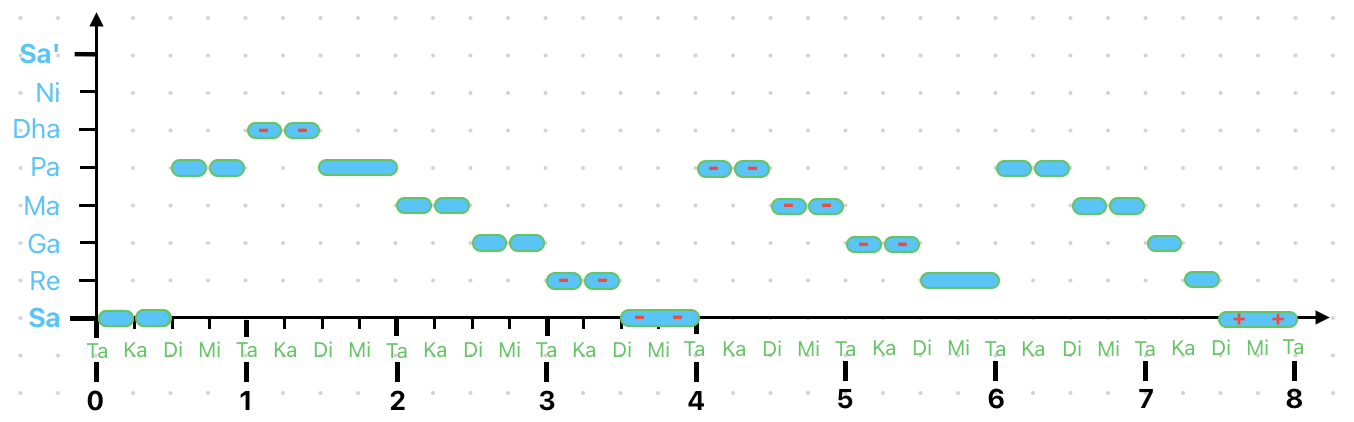
Here are the decoded versions of all 3 layers:
Loudness:
Ya Ya Ya Ya Ve Ve Ya, Ya Ya Ya Ya Ve Ve Ve, Ve Ve Ve Ve Ve Ve Ya, Ya Ya Ya Ya Ya Ya Ha.
Time:
Ta Ka Di Mi Ta Ka Di, Ta Ka Di Mi Ta Ka Di, Ta Ka Di Mi Ta Ka Di, Ta Ka Di Mi Ta Ka DiT.
Pitch:
Sa Sa Pa Pa Dha Dha Pa, Ma Ma Ga Ga Re Re Sa, Pa Pa Ma Ma Ga Ga Re, Pa Pa Ma Ma Ga Re Sa.
Combining them into one integrated visual representation according to the conventions we’ve adopted in this series, we get:
And we’re done!
What’s Next?
The next part will introduce us to the 5 melodies that we will be decoding by ear.
Do you love music? And learning? If you’d like to discover some of the more intimate intricacies of music and support me along the way, please consider subscribing. I’d love to learn from you as well!