
Prime Time
Gati: Part 9

Gati Multiples
How many gatis exist?
Here’s a rhythm:
What is its gati, i.e. into how many subdivisions is each each tempo-duration (duration between the bass beats) divided?
If you guessed a gati of 2, you’re right.
But what happens if I remove every second tempo-beat (bass beat) without changing the other beats, like so:
What gati would you assign to this rhythm now?
It’s now changed to a gati of 4, and the tempo is half of what it was earlier.
Composite Gati
It seems like the same rhythm can be assigned 2 different gatis, depending on the choice of tempo.
But which is the “right” one?
Simply put, that’s for us to choose.
In fact, a single rhythm might have multiple tempo-gati combinations that work for it, and finding the right one is just about expressing our unique rhythmic intent.
Without getting into the weeds of gati combinations, what we can see here is that the 2 gatis above are related in a simple way: 4-gati is just a multiple of 2-gati.
Let’s compare them as audio, with the 2-gati followed by the 4-gati:
Prime Gati
Taking this idea forward, we can represent 4-gati as a subspecies of the 2-gati flower from earlier.
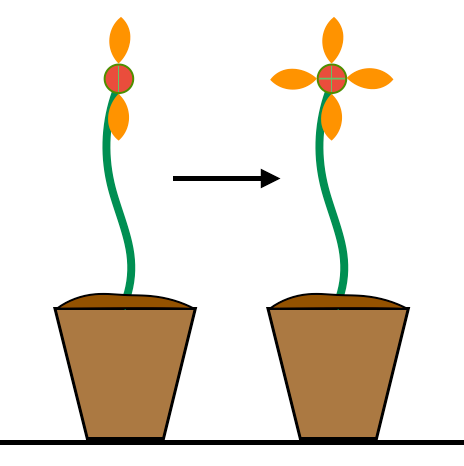
Similarly, we might represent a 9-gati as a subspecies of the 3-gati flower like so:
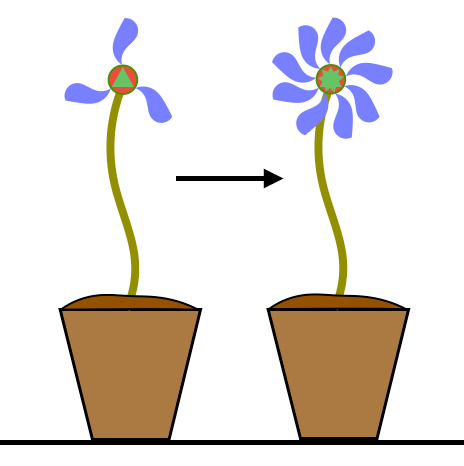
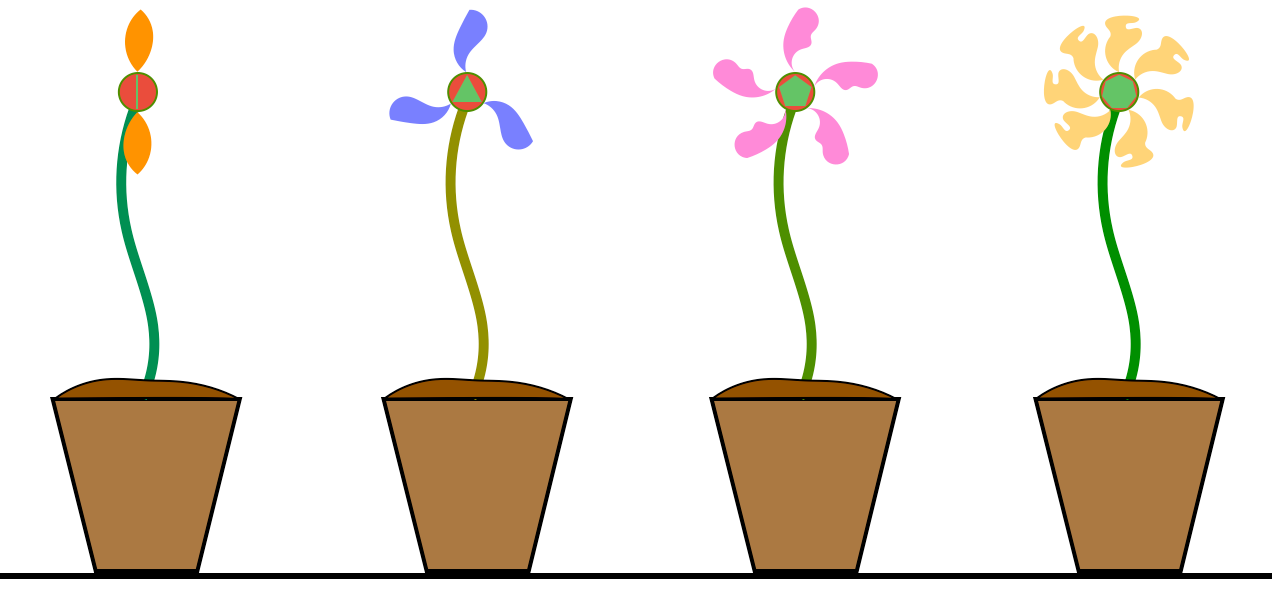
Hopefully, this makes it clearer why we chose 2-gati, 3-gati, 5-gati and 7-gati as our 4 primary gati flowers. These are prime gatis, from which other gatis can be derived.
When nothing but oneself divides
You must be in your prime.
— Trianglehead Chronicles
Once again, here are the foundational flowers of our representational system:
Gati Flowering
What about a gati of 6? Do we represent it as a subspecies of the 2-gati or the 3-gati?
Well, it’s a cross between both varieties. Here’s one way for how to represent it:
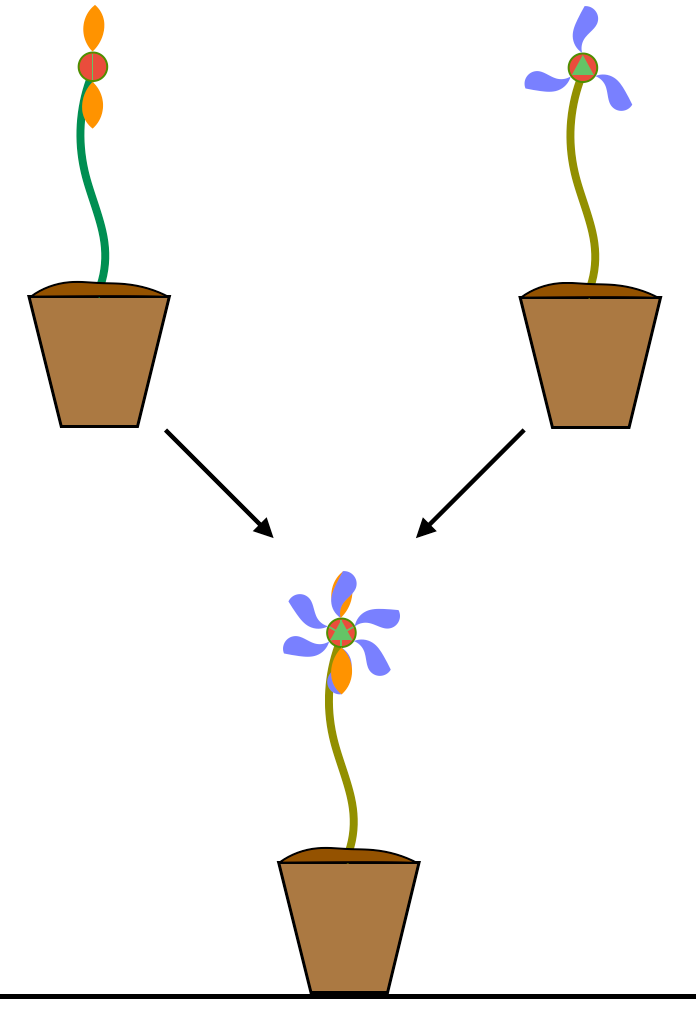
So, from prime gatis, which include our usual 2-gati, 3-gati, 5-gati and 7-gati, but also others like 11-gati and 13-gati, we can understand, relate and represent any whole-number gati.
Shared Petals
Just as the petals of the 6-gati include the petals for both 2-gati and 3-gati, there’s another very obvious petal-sharing aspect that we can now make explicit in our gati representation.
Maybe you’ve already noticed this, but the first Ta of any gati is identical in terms of timing: they’re all simultaneous with the tempo-beat.
So it’s only natural that we represent this first Ta as the same petal, no matter the choice of gati.
With this change, this is how the gatis from 1 to 10 will now appear, shown here along with their respective solkattu phrases:
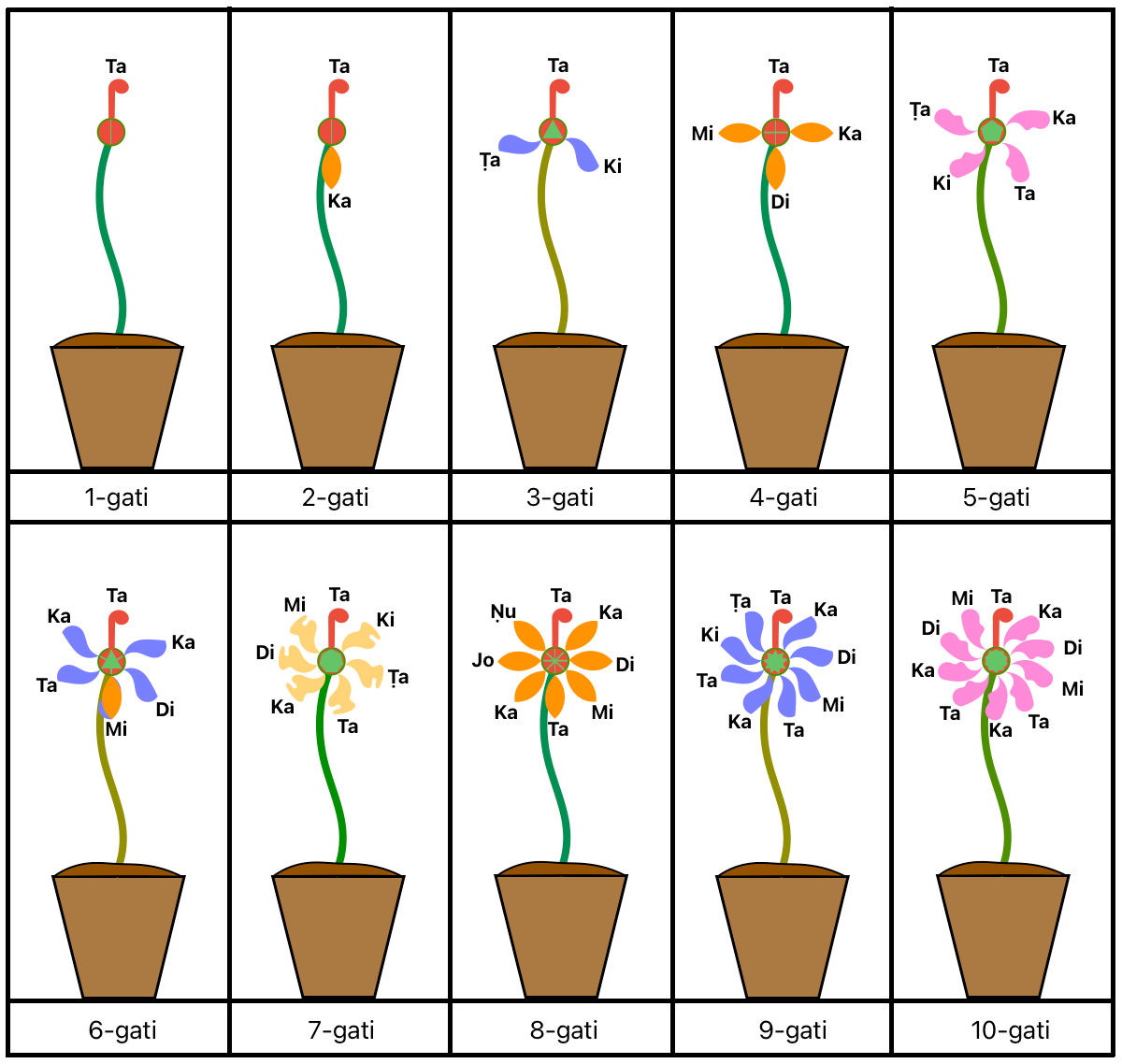
Let’s listen to this sequence of gatis, with each gati lasting for 4 tempo-beats:
On and On…
Theoretically, there’s no limit to how many gatis exist. Practically though, even a gati of 10 is quite fast, and therefore challenging to keep up with.
This is why gatis greater than 9 are relatively rare, and gatis greater than 15 are pretty much unheard of.
This means that in practice, having a command of just a few gatis is more than sufficient to decode almost any rhythm.
What’s Next?
We’re done with the foundations of gati. All that’s left is to challenge ourselves with recognising gatis and gati phrases in real-time.
Do you love music? And learning? Well, then Sound Insight is the place for you!
If you’d like to spread what you’ve learnt (and support me along the way ;D), please consider sharing this post.
If you’d like to learn more, please reach out through comments/DMs. I’d love to learn from you as well :)