
Pitch Space
Scale: Part 8

Scales as Summaries
You can think of a scale as a summary of the pitch variations in a section of music.
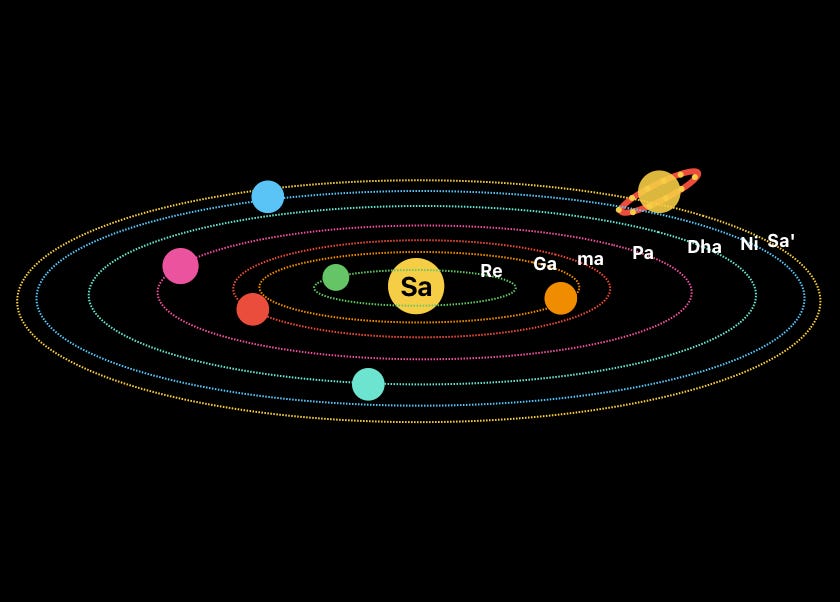
Like any summary, it can never give a complete picture of the original piece of music. Nevertheless, it’s a great way to understand how pitches affect mood, or — pardon the technical language — vibes.
Different sets of pitches come together to form different scales, each with a slightly different mood.
Here are the pitch summaries we have for the 4 melodies from Part 3:
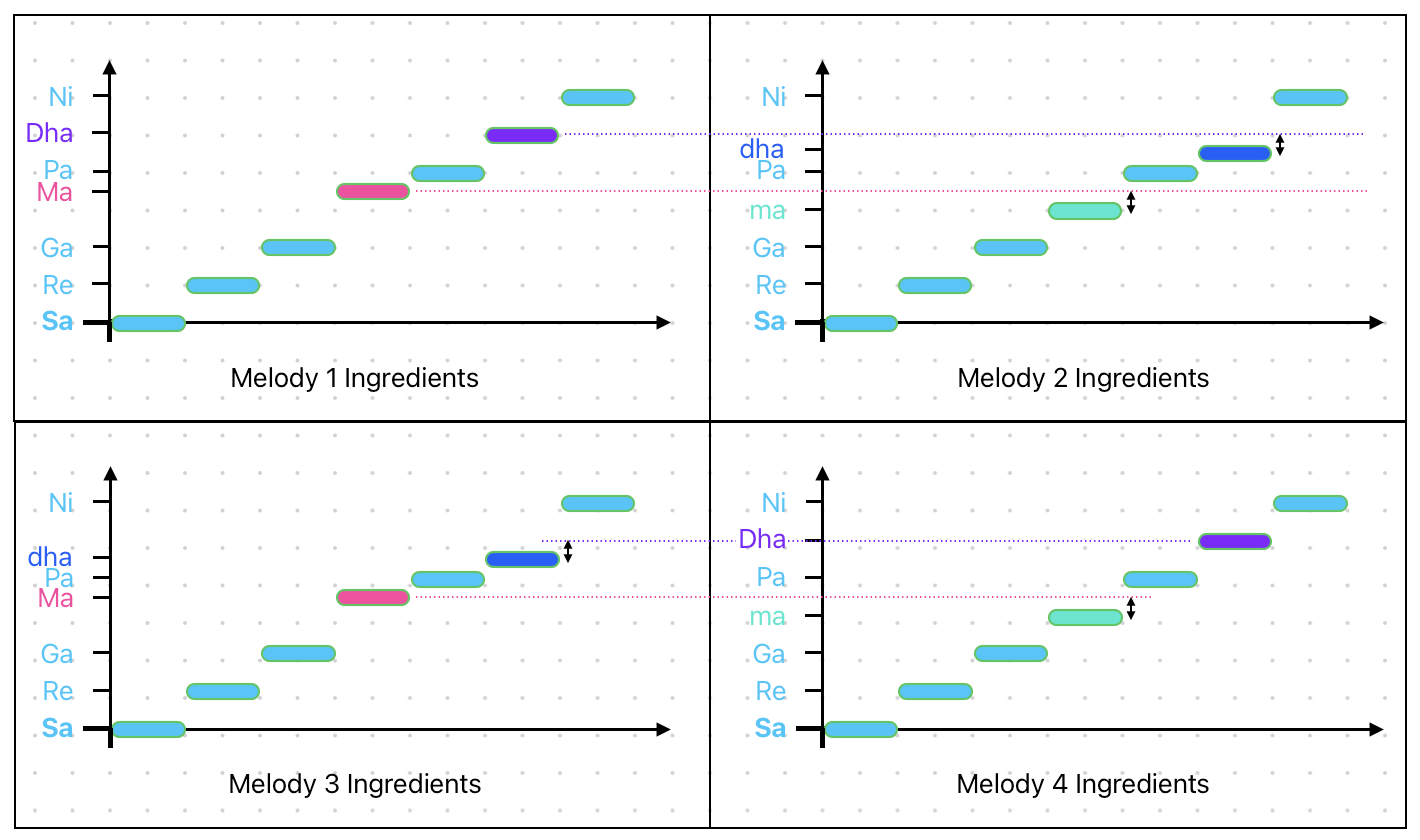
This is how these 4 scales sound in order:
4 melodies have given us 4 scales. How many other scales exist?
In order to answer this, we’ll need to know how many other pitch options we have available for selection.
And to figure that out, we’ll need to understand what lies in the space betwixt 2 pitches.
Pitch Gaps
In Part 2 of Decoding Melody, we were introduced to the idea of a pitch interval. At its core, an interval is the relationship shared by 2 pitches.
We quantify a pitch relationship by thinking of it as the distance between 2 pitches.
So, the distance between Ga and Dha is one kind of interval, and the distance between Sa and Re is another.
Thinking of intervals as distances allows us to compare relationships among multiple pairs of pitches. At the simplest level, this means that we can order intervals according to size.
Ordering Gaps
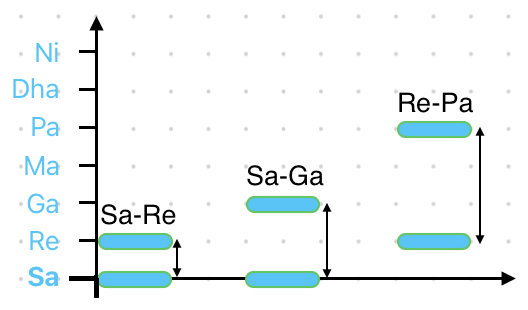
For example, if we have 3 pairs of pitches:
Sa-Re
Re-Pa
Sa-Ga
We can order the 3 resulting intervals like this:
Sa-Re < Sa-Ga < Re-Pa.
You can convince yourself of this by looking at a visual representation:
Even better though, would be to convince yourself of this by listening to these 3 (harmonic) intervals:
While the visual representation we’ve used works well enough for the 3 intervals above, there are other cases in which it fails to present the right picture.
We’ve seen in Part 6 how, unlike direct audio-domain pitch-comparison, a picture might not tell the whole story of pitch (and interval). This is, unfortunately, the case even for our present visual representation.
It’s high time we change that, by using our ears.
I--N--T-E--R--V--A-L
In order to correct our inaccurate visual representation for pitch, we’ll need to compare the pitch intervals in any of the 4 scales above.
Let’s categorise all adjacent-pitch intervals in the 7 pitches of Melody 4:
Sa-Re
Re-Ga
Ga-ma
ma-Pa
Pa-Dha
Dha-Ni
Ni-Sa'
We’ll keep it simple, and categorise these 7 intervals into just 2 buckets: large and small.
Listen to these 7 adjacent pitch-pairs, arranged in the same order as above, and try to categorise them [Hint: only 2 of the 7 intervals are in the small bucket]:
Were you able to tell that the intervals between Ga-ma and Ni-Sa’ were smaller than the others? If not, listen to the audio again and try to spot these 2 relatively smaller intervals.
Here’s a representation of Melody 4’s pitches from earlier:
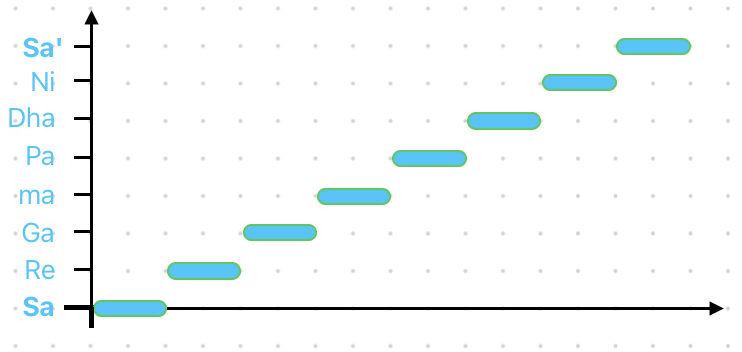
If we modify this to reflect relative interval sizes (large and small), we get this newer and more accurate visual representation for the pitch-ingredients of Melody 4:
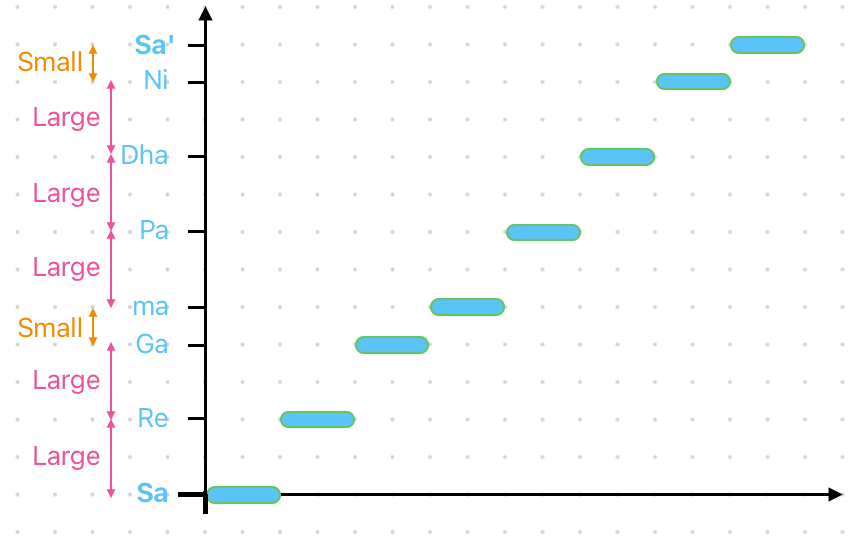
Gotta Catch ‘em All
Here’s a 3-part challenge for you, before we go on to systematically develop our pitch-and-scale framework:
How many more pitches do you think we’d need to fill in the gaps between the pitches above?
Once you have a number, can you justify it? Why not a greater or lesser number of pitches?
Can you imagine (or sing/play) what these newer pitches will sound like?
What’s Next?
We’ll delve deeper into the gaps in our current pitch framework.
Do you love music? And learning? Well, then Sound Insight is the place for you!
If you’d like to spread what you’ve learnt (and support me along the way ;D), please consider sharing this post.
If you’d like to learn more, please reach out through comments/DMs. I’d love to learn from you as well :)