
Basecamp
Melody: Part 24

After winding our way through the foothills of melody, we’ve finally reached base camp, ready for our first major ascent: decoding entire melodies by ear.
Before embarking on the trail, let’s learn about what we’re up against it, and the extent to which our visual abilities can assist us.
The Terrain
For many of us, the visual representation of a melody feels easier to comprehend than its audio version. Why?
For a start, each melodic element is visually represented in a very simple way:
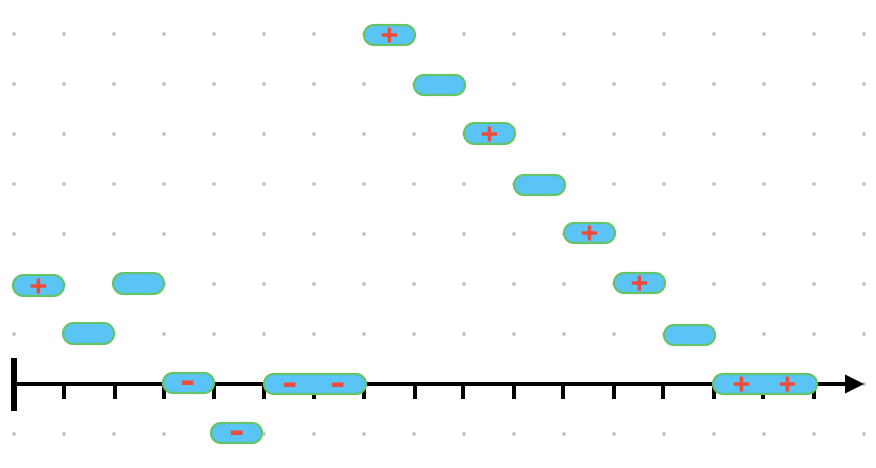
we can clearly see the relative distance of each pitch from the baseline Sa,
we can easily tell the timing of every pitch by noting its starting position (and duration) with respect to the clearly marked, vertical tempo-beat lines, and
decoding loudness is extremely simple, with just 3 visibly textured patterns, where the middle range Ya acts as reference.
More generally though, there could be other factors at play, some of which we will explore through the audio and visual challenges in this post.
Getting to Know Ourselves
The explorations/exercises that follow should acquaint us with how our visual and audio skills match up against each other.
This is not intended to be a test. It’s nowhere close to being rigorous. It’s just one possible (and hopefully fun) way to shine a light on how we perceive visual and audio elements.
Think of it as a way to discover something about yourself.
Each section will consist of a visual exploration followed by a closely related audio exploration for comparison.
You can find solutions to all the challenges in the Solutions section at the end of this post.
Have fun!
Skill 1: Recognition
Visual
In the top half of the image below, there are 3 types of shape (named J, K and L).
K is symmetrical, while the other two are not.
J has a shorter line on the left while L has a shorter line on the right.
In the bottom half of the image, the lines are erased to show the corresponding point-versions of these shapes.
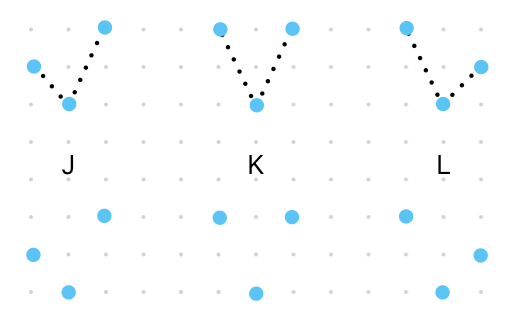
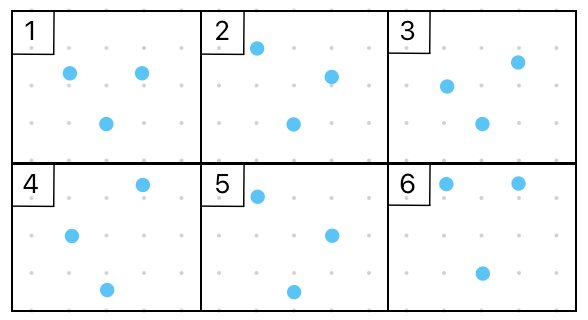
Classify each of the following 6 examples into one of the above types of shape, i.e. J, K or L.
Audio
Now, consider 3 representative pitch contours, corresponding to the 3 shapes from above, in the same order.
Each pitch contour consists of 3 pitches.
The pitch contours have an exact correspondence to the points in J, K and L above:
The first contour’s starting pitch is lower than its ending pitch, corresponding to J.
The second contour’s starting and ending pitch are the same, corresponding to K.
The third contour’s starting pitch is higher than its ending pitch, corresponding to L.
Here are the J, K and L pitch contours in order:
Classify the following six examples into one of these 3 types of pitch contour, i.e. J, K or L.
Which did you find easier: Visual Recognition or Audio Recognition?
Skill 2: Measurement
Visual
Below is a set of 6 points with labelled regions between adjacent pairs of points. These 5 regions with distinct lengths are labelled P, Q, R, S and T.
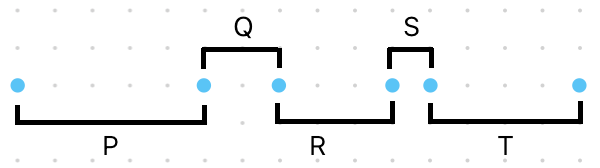
Arrange the above regions in increasing order of length.
Audio
Below is a set of 6 beats, with each adjacent pair of beats separated by regions of time. Let’s call these regions of time, of distinct durations: U, V, W, X and Y.
Arrange these 5 regions of time in increasing order of duration.
Which did you find easier: Visual Measurement or Audio Measurement?
Skill 3: Search and Recall
Complete the Search section before attempting the Recall section.
Search
Visual
Here are 3 kinds of texture, Ve, Ya and Ha:
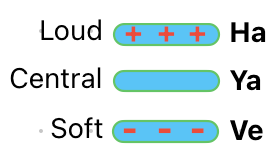
Of the following 20 boxes with varying lengths and textures, what is the texture label (Ve, Ya or Ha) of the box with the longest length?

Audio
Here are 3 kinds of loudness, Ve, Ya and Ha, in increasing order of loudness:
Of the following 20 pitches with varying durations and loudness, what is the loudness label (Ve, Ya or Ha) of the pitch with the longest duration?
Which did you find easier: Visual Search or Audio Search?
Recall
Visual
Attempt the following without looking at the above picture of the 20 boxes:
Both the first box (top left corner) and last box (bottom right corner) have the same texture label. Is it Ve, Ya or Ha?
Audio
Attempt the following without listening to the above audio of the 20 pitches:
Both the first pitch and last pitch have the same loudness label. Is it Ve, Ya or Ha?
Which did you find easier: Visual Recall or Audio Recall?
Skill 4: Perceptual Stability
Visual
Consider the 3 arrangements of ascending points below:
Each arrangement consists of 3 points.
The straight-line distance between the leftmost (lowest) and middle point is M, and the straight-line distance between the middle and rightmost (highest) point is N.
Either M and N are equal or they are unequal.
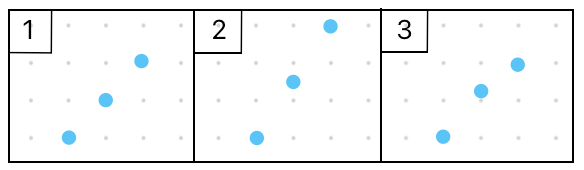
Of the 3 arrangements above, which one has M unequal to N?
Audio
Similarly, consider the 3 arrangements of ascending pitches in the below audio:
Each arrangement consists of 3 pitches.
The interval (i.e. pitch distance) between the first and second pitch is K, and the interval between the second and third pitch is L.
Either K and L are equal or they are unequal.
Which one of these 3 pitch arrangements has K unequal to L?
Which did you find easier to maintain: Visual Perceptual Stability or Audio Perceptual Stability?
Skill 5: Mark Comprehension
Visual
What are the pitch and loudness values of the 11th box (from the left) in the visual melody shown below?
Audio
Listen to the audio below.
What makes it special is that it contains not only a regular melody, but also a reference Sa played simultaneously on every inner beat (Ta, Ka, Di and Mi) with loudness matching each melodic pitch.
It is essentially a melody combined with all 3 melodic element references.
Firstly, is this audio melody exactly the same as the above visual melody?
And secondly, what is the duration (1 or 2 or 3 or… inner beats) of the 10th pitch in this audio melody?
Which did you find easier to comprehend: Visual Marking or Audio Marking?
My Journey with Visual Representations
Perhaps, like me, you found the visual explorations relatively easier to complete than the audio ones. Then again, maybe not.
Either way, I’d love to know about your experience with these explorations and what you may have learnt about yourself in the process. Let me know in the comments.
Speaking of my own experience, here are some reasons why I find visual methods to be a great gateway into melodies, and even music in general:
Recognition: I’ve had a deep familiarity with the visual medium in day to day life, making it easy to recognise shapes, lines, points and distances.
Measurement: My ability to perceive distance and texture allows me to accurately compare visual attributes in the representations for pitch, time and loudness.
Search and Recall: I don’t need to memorise the exact visual representation of any melody since it’s always accessible as a static image. If I forget where something is or how it looks, I just need to look at it.
Perceptual Stability: Looking at one part of the image doesn’t often confuse my perception of a different part of the image.
Mark Comprehension: Even if I omit text labels and only include visual references and units for each melodic element, the visual representation is still easily and precisely comprehensible.
While visual representations are handy tools in my musical toolkit, I do realise that they allow me to experience the beauty of music about as much as reading recipes allows me to savour food.
They have their many valuable uses, but are not a substitute for the real thing. And this is why my perennial, primary goal is to engage with music on the level of sound.
In line with this, the rest of this series is dedicated to decoding melodies purely by ear. We’ll use visual representations only to conceptualise what we have decoded from the audio.
Solutions
Skill 1: Recognition
Visual: 1 - K, 2 - L, 3 - J, 4 - J, 5 - L, 6 - K
Audio: 1 - K, 2 - J, 3 - K, 4 - L, 5 - L, 6 - J
Skill 2: Measurement
Visual: S < Q < R < T < P
Audio: V < W < Y < U < X
Skill 3: Search and Recall
Visual Search: Ya (bottom row, 2nd from left)
Audio Search: Ha (starting at 0:09)
Visual Recall: Ve
Audio Recall: Ha
Skill 4: Perceptual Stability
Visual: Third arrangement
Audio: First arrangement
Skill 5: Mark Comprehension
Visual: Ma, Ha
Audio: Q1. No; Q2. Ma, 2
What’s Next?
To acclimatise to the terrain of decoding melodies by ear, we’ll walk through the process of decoding a familiar childhood melody.
Do you love music? And learning? If you’d like to discover some of the more intimate intricacies of music and support me along the way, please consider subscribing. I’d love to learn from you as well!
For me :
skill 1: found both audio and visual equally effective
Skill 2-5 : definitely visual was better but just for skill 3 recalling … audio was easier