
The Centre for Loudness
Melody: Part 21

We’re almost at the end of our exploration of loudness.
In Part 20, we saw how silence might not be the best relative loudness reference when listening to a melody. Let’s look for an alternative.
This will lead us to finally decode the loudness pattern of The Melody!
Generally Speaking
Imagine having a conversation with a close friend. It’s likely that you’ll both naturally vary your loudness in the course of speaking:
There will most likely be an average conversational loudness that gets used most of the time. Let’s call this the central loudness.
In addition, there might be parts of the conversation dominated by louder speech, perhaps from joy, excitement or even anger. Let’s call this loud.
There might also be parts when you speak softly, maybe because you’re sad, or because the librarian doing rounds is telling you to be quiet, or because you’re stunned that the librarian is doing their rounds at your friend’s place. Let’s call this soft.
So, in increasing order of loudness, we have 3 ranges:
Soft
Central loudness
Loud
These ranges are specific to one person’s speaking situation. We each have a different central loudness, which varies depending on the circumstances surrounding our speech (where, when, with whom, …).
This kind of relative labelling gives us the ability to tie loudness to context without changing the loudness labels we use for each melody.
Let’s apply this idea to melodic loudness.
Central Melodic Loudness
We can think of melody as a single voice’s musical speech. And a single person’s speech, as we’ve seen, happens primarily at the central loudness, punctuated by moments of louder or softer levels.
This lets us use the 3 relative loudness labels above, to the pitches of any melody. Also, this naturally reorients us towards a new reference for loudness.
Compared to silence, the central loudness is more convenient as a relative reference, because many of a melody’s pitches tend to be at this level. Silence, on the other hand, is the loudness of none of the pitches.
At the risk of overgeneralising, the central loudness plays the role that Sa does in pitch, or Sam does in time.
A Change in Symmetry
Let’s use what we’ve learnt to completely revamp our loudness dictionary.
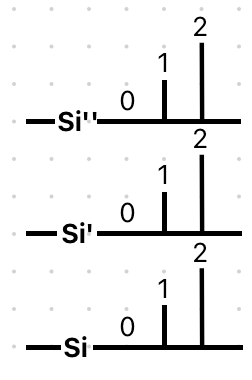
Here’s an overview of our current loudness dictionary:
It has 3 spans with 3 levels each (0, 1 and 2).
The reference for each span is its lowest level, 0.
The lowest Si-span is the reference for the other two (Si' and Si''):
All of these things are about to change:
We’ll rename the inner levels to -1 (minus one), 0 and 1.
This new 0 will now be the central level of each span. This will become the span reference.
The central span reference will now be the basis for naming the other two. Let’s call the central span reference Ya. This will give us 3 Ya-spans (similar to the 3 earlier Si-spans):
_Ya at the bottom
Ya at the centre
Ya' at the top
With these changes, here is our new loudness dictionary:
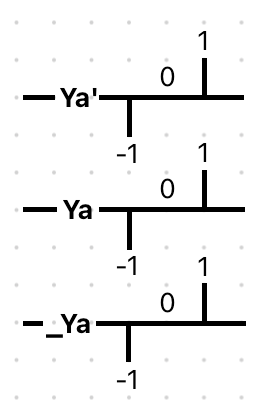
With these changes, both levels and spans now have the same kind of centrally referenced symmetry.
Close Enough
Now that we’ve changed our reference, Si has been reduced to a separate level that stands apart from the others:
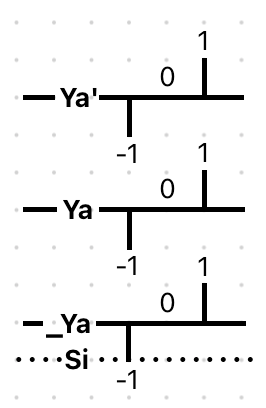
This looks complicated though. Fortunately, we can relax our loudness precision in practice.
As a quick example, let’s look at how we relax precision in a very different sphere: number approximation.
If you only care about the natural numbers 0, 1, 2,… then a number like 1.3 can be approximated as 1. 0.9 becomes 1 as well, while 0.2 turns into 0. This is basic rounding off.
Approximating Loudness
We’re going to take a similar approach with loudness. Instead of having to keep track of many loudness levels, we’ll use just 3 to label any loudness other than silence:
Ve: soft,
Ya: central loudness, and
Ha: loud.
What if the loudness of a pitch is between one of these levels? We simply label it with whichever of these 3 levels is closest to it. So if a melody’s pitch has a loudness between Ya and Ha, but is closer to Ya, we’ll label its loudness as Ya.
This turns the loudness dictionary into:
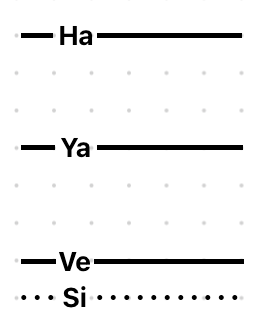
Much simpler! We’re only using the Ya-spans now.
The central range Ya is our reference. Anything significantly louder is Ha while anything significantly softer is Ve. If something is so soft that we don’t hear it, it’s Si.
A hidden advantage of this system is that we can choose to introduce greater or lesser precision anytime we want with the addition or removal of levels. This puts its extensibility of precision on par with that of our pitch and time frameworks.
Refining the Loudness Dictionary
To be fair though, the above visual representation is not entirely transparent in showing how we’re approximating in-between levels.
A clearer representation would show how we’re actually labelling ranges, each with a central Ya-span (Ve, Ya and Ha).
This would give us a representation where Si is (arguably) a loudness level while Ve, Ya and Ha are effectively loudness ranges.
So strictly speaking, our loudness dictionary should look like this:
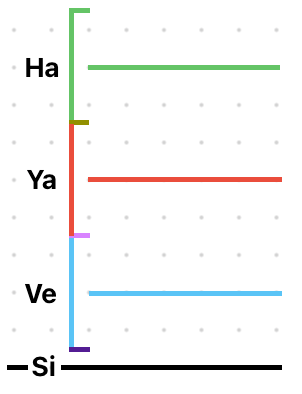
Going forward though, we’ll use a much simpler loudness dictionary.
Whenever we represent the loudness of a pitch, we’ll use a point, while keeping in mind that it actually represents a range.
To simplify even further, we’ll omit silence. And finally, here’s our loudness dictionary:
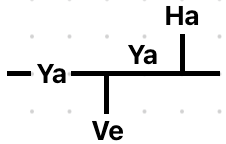
Loudness Sensitivity
Here’s a melody:
And here is its loudness pattern:
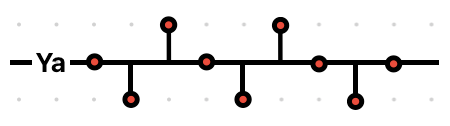
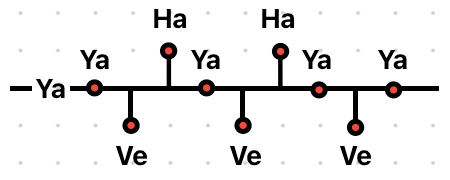
Using the latest version of the loudness dictionary, try to label the loudness of each pitch of this melody.
This is what you should get:
The Melody and its Loudness
What’s the loudness pattern of The Melody?
Here’s The Melody:
You’re probably quaking with suspense to find out its long-awaited loudness pattern. Without further ado, here it is:
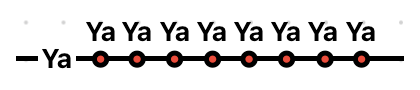
Ah! What a complex, interwoven web of loudness levels! The intellect falters.
What’s Next?
We’ve spent the last 3 parts of the Melody series building up to a thrilling climax: the loudness pattern of The Melody. We’ve now successfully eased this tension by dramatically revealing The Melody’s loudness pattern in an epic and ultimately satisfying way.
So, in the next part, we’ll decode the loudness patterns of a few melodies by ear, without any visual aids.
Do you love music? And learning? If you’d like to discover some of the more intimate intricacies of music and support me along the way, please consider subscribing. I’d love to learn from you as well!